The Best Prop Trading Firms in 2025
While everyone says the main attraction of prop firms is access to huge trading capital without risking your own money, the reality is that you often have to risk your own funds upfront to buy a “challenge” or meet evaluation conditions. The real appeal lies in what comes next: autonomy, scalability, and significant rewards, for traders good enough to earn them.
Finding the right firm is more critical than ever in 2025. The industry has surged over 600% in the past four years, now estimated at a $20 billion valuation. That explosion means more opportunities, and more noise. In this guide, we cut through marketing hype, comparing the Top 5 prop trading firms for experienced traders, highlighting rules, payouts, feedback, and tradeoffs.
We evaluate:
- OneFunded
- FTMO
- FundedNext
- Topstep
- The Funded Trader (TFT)
Each firm gets a deep dive plus side-by-side rule comparison. Use this as your monthly updated reference to spot shifts early.
Comparative Rule Table: Key Metrics
Below is a comprehensive table comparing rules and trade conditions across the five firms. Use this as your cheat sheet. (Always double-check live websites.)
| Firm | Minimum Initial Capital Offer | Profit Share (up to) | Evaluation Fee (Lowest Tier) | Key Instruments | Unique Feature Highlight | Platform Support |
| OneFunded | $2,000 | 90% | $23 | Forex, Indices, Commodities, Crypto, Stocks | Rewards Center, No time limits, transparent rules | cTrader, TradeLocker |
| FTMO | $10,000 | 90% | €89 | Forex, Indices, Commodities, Crypto, Futures (demo) | Industry veteran with top-tier reputation & analytics | MT4, MT5, cTrader, DXtrade |
| FundedNext | $2,000 | 95% | $35 | Forex, Indices, Commodities, Crypto, Futures | Highest profit splits & balance-based drawdown option | MT4, MT5, cTrader |
| Topstep | $50,000 | 100% | $49 | Futures | 100% profit on first $10k | TopstepX |
| The Funded Trader | $5,000 | 90% | $65 | Forex, Indices, Commodities, Gold, Crypto | Strong community, frequent promotions, diverse account types | cTrader, Match-Trader, MT5 |
Use this table as your first filter: eliminate firms whose rule combinations don’t match your strategy.
1. OneFunded (Best Overall in 2025)
Evaluation and Capital Model
OneFunded offers flexible challenge programs, 1-step or 2-step variants, designed to accommodate both swing traders and more aggressive styles. Traders choose the account size, pay the evaluation fee, trade within rules, and upon passing, they receive a funded (virtual) account. Capital sizes range from $2,000 to $100,000
The founder’s focus is on no strict time constraints, shorter stress, and a “trader-first” ethos. OneFunded includes a Rewards Center, redeemable points for free or discounted challenges, a rare feature in prop firms.
Rules, Risk & Trader Requirements
- Profit target: 7-8% in phase 1, 4-5% in phase 2 (or combined ~10% for one-step)
- Daily loss limit: 4–5% depending on challenge type
- Max drawdown: 6% to 11% (varies by version)
- Minimum trading days: 2-5 days
- Time limits: None
- Scaling/lift: No
- Allowed strategies: Depending on the plan, EAs, trade copiers, and news trading are allowed
- Payout cycle: Weekly and biweekly with add-ons
Trustpilot & Trader Feedback
While OneFunded is newer relative to giants like FTMO, the feedback is promising:
- Trustpilot score consistently high (approx 4.4 / 5) with hundreds of reviews.
- Trustpilot ratings suggest strong satisfaction around support, clarity, and payout execution.
- Traders appreciate the communication transparency and minimal surprises.
- Some caution: very aggressive traders may find the capital ceiling per user restrictive.
Pros & Cons
Pros:
- Extremely flexible evaluation time
- High profit split (up to 90%)
- Reward/discount system adds value
- Transparent rules and good support per reviews
Cons:
- Shorter operational history
- No Scaling policies
- Virtual-funded (initial backing) may deter ultra-conservative traders
2. FTMO (Industry Gold Standard)

Evaluation Process & Capital Growth
FTMO requires traders to clear two steps: Challenge and Verification. The Challenge demands a set profit target within risk limits; when passed, the trader moves to Verification with a milder target and the same or stricter risk constraints. On success, the trader is placed into a real funded account.
Capital sizes range from $10,000 to $200,000 (or more in premium tiers). FTMO also offers scaling plans enabling growth up to multi-million-dollar manage sizes.
Rules & Risk Structure
- Profit targets: ~10% in Challenge, ~5% in Verification
- Daily loss limit: 5% on any given day
- Overall drawdown: 10% max drawdown
- Minimum trading days: 4 trading days are required during the phases
- Time limits: Each phase has a deadline (often 30 days or time-bound)
- Scaling: Performance triggers access to higher capital tiers
- Instruments: Wide support ,Forex, commodities, indices, CFDs
- Not allowed: Some EAs, hedging, overnight rule violations, e.g., “one-sided” aggregation overuse
Trustpilot & Trader Reviews
FTMO enjoys a stellar reputation:
- Trustpilot score consistently high (approx 4.8 / 5) with tens of thousands of reviews.
- Traders praise fast payouts (within 24–48 hours), transparency, responsive support teams.
- Some say they received payouts in less than a day.
- Detractors often point to rule violations, traders being disqualified for nuanced infractions (e.g. breaking “one-sided” rules, micro-lot hedges).
- Some mention challenge refunds being reliable and consistent.
FTMO is the benchmark, many newer firms emulate FTMO’s rule set.
Pros & Cons
Pros:
- Long track record and strong credibility
- Strict but fair rules with detailed analytics
- Transparent scaling and growth path
- Reliable and fast payout infrastructure
Cons:
- Strict rule enforcement means high risk of account termination
- Challenge fees are among the higher ones
- Time limits impose pressure on slower traders
3. FundedNext (Modern Flexibility)
Overview & Funding Approach
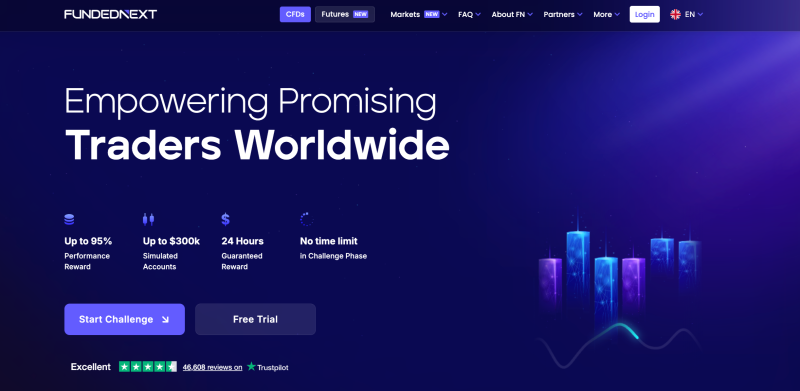
FundedNext distinguishes itself via flexibility. It offers multiple challenge styles, 1-step, 2-step, with fewer time constraints. In some plans, they allow trading during the evaluation with profit-sharing, which is rare in the industry.
They advertise support for MT4, MT5, cTrader, and occasionally integration with TradingView, giving more platform flexibility.
Rules, Risk & Structure
- Profit targets: ~8% + 5% in two-step challenges
- Daily loss limit: ~4–5 %
- Max drawdown: ~10% (with balance-based options in some modes)
- Minimum trading days: Some plans impose 5 trades; others require no minimum days
- Time limits: Many challenges have no hard deadlines
- Scaling: Less formulaic than FTMO; internal review often governs growth
- Allowed strategies: EAs, hedging, trade copiers allowed in some plans (check exact variant)
Trustpilot & Trader Sentiment
- FundedNext holds around 4.6 / 5 on Trustpilot from many reviews.
- Users often praise the UI, challenge flexibility, and reportedly fast payout speed (within 24 hours for some).
- Some complaints revolve around KYC delays or removed payment options.
- On forums, traders note that rules on EAs or copier systems may vary per contest.
Pros & Cons
Pros:
- High profit splits (up to 95% in premium tiers)
- Flexible challenge deadlines
- Broad platform / instrument support
- Attractive to traders using algorithmic strategies
Cons:
- Scaling is less transparent
- Some rule ambiguities (EAs / copier use) in certain variants
- Being newer, long-term consistency still being proven
4. Topstep (Futures-Focused & Reliable)
The “Trading Combine” Model
Topstep’s path to funding is via the Trading Combine® system. Traders pass stages in simulated accounts under strict risk rules. Once they satisfy the Combine targets, they receive funded status. Many traders using futures markets (e.g., ES, NQ) choose Topstep for its established emphasis on futures rules and community.
They’ve rolled out TopstepX, a new platform and service suite designed for prop traders.
Rules & Risk Parameters
- Profit target: Varies per Combine tier
- Daily loss cap: Enforced per specific Combine plan
- Max drawdown / trailing loss: Enforced depending on plan
- Minimum days: Set by Combine rules
- Time limits: Subscription continues until funded or cancelled
- Profit split: You keep 100% of first $10,000 unlock, then ~90% onward
- Instrument set: Futures primarily (limited CFDs/Forex support)
- Position rules: Must often flatten positions daily, respect contract limits
Trustpilot & Feedback
- Topstep’s Trustpilot reviews are strong: many users mention the evaluation process is intuitive and payouts are reliable
- Users say the UI is user-friendly, dashboard smooth, support helpful.
- Some mention express payout issues in some cases, but generally regarded as trustworthy in the futures prop space.
Pros & Cons
Pros:
- Highly trusted by futures traders
- Clear rules and strong community support
- Unique profit-safety (100% on first $10K)
- Scalable to larger funded statuses
Cons:
- Less flexible for non-futures traders
- Subscription model (or monthly fees) until funded
- Must adapt to rules like flattening positions daily, tight contract constraints
5. The Funded Trader Program (TFT)

Evaluations & Funding Modes
TFT offers several challenge variants: Rapid, Royal, Knight, etc. They provide one-step and two-step models, each with unique rule sets to cater to various styles.
For example:
- Rapid Challenge: Payout may be possible ~16 days from start, 0 minimum trading days per phase, phase targets 8% / 5%.
- Royal Challenge: 5 minimum days per phase, 8% phase target, 10% drawdown / 5% daily limit.
- Knight Challenge: Single phase, 10% target, 6% max drawdown, 3% daily drawdown.
They also enable more flexible methods (EAs, trade copiers) in certain plans.
Rules & Risk
- Daily loss limit often ~3–5%
- Max drawdown ~6–10% (varies by mode)
- Minimum trading days: 0 to 5
- Profit targets: 8% / 5% or 10% single-step
- Scaling opportunities exist for consistent performers
- Payouts: As early as 16 days in some plans
Trustpilot & Trader Feedback
- TFT’s Trustpilot rating is more moderate, with mixed reviews.
- Many users report successful payouts and friendly community engagement.
- Others caution about rule enforcement, communication delays, or account access glitches.
- Sample feedback:“I can no longer access my dashboard … no support responses.” red flag posts.
TFT’s strength lies in flexibility and community, but it demands that users test carefully and validate payout consistency early.
Pros & Cons
Pros:
- Many challenge variants to suit diverse strategies
- EAs / Copier allowed in some plans
- Fast funding cycles in certain modes
- Moderate capital requirements (accessible)
Cons:
- Mixed reputation in payout consistency and support
- Rule variants require careful plan selection
- Platform instability or access issues reported
Rule Sensitivity & Strategy Fit: How to Decide
To pick the right prop firm, go beyond “which has the biggest split.” Match the firm’s rules to your trading behavior. Below are key dimensions:
| Your Trait / Preference | Ideal Rule Trait | Firms Best Matching |
| Slow swing trader, no daily pressure | No daily loss limit or looser daily caps | OneFunded, FundedNext |
| High-frequency or scalping style | Tight rules, short phase, forgiving daily cap | FTMO (if careful) |
| Futures-only strategy | Futures-first instruments, zero leverage restrictions | Topstep |
| Algorithmic / EA / copier | Permissive rules for automated strategies | FundedNext (select plans), TFT (in some modes) |
| Maximum capital scaling | Transparent scaling path, high cap | FTMO, OneFunded (as they grow) |
| Risk-averse about payout reliability | Established firm with track record | FTMO, Topstep |
Other points to factor:
- Rule exceptions matter: Some firms allow news trading, others ban it.
- Hidden contract limits: e.g. only allowed 5 contracts per instrument.
- Inactivity policies: Some firms disable accounts after 30 days idle.
- Margin & leverage rules: Not always obvious in marketing.
- Payout thresholds & minimums: Even if split is high, you may need $150–$500 profit before withdrawal.
- Challenge refund policies: Some firms refund your evaluation fee after your first payout.
In short: your strategy must align with the firm’s structural regime, not the other way around.
More In-Depth Comparisons & Clarifications
Time Limits & Evaluation Flexibility
Though firms often advertise “no time limits,” in practice:
- Some challenges embed soft deadlines: e.g., “must finish in 60 calendar days or restart.”
- Subscription models (like Topstep) act like de facto time limits — you pay longer for more time.
- Delayed funding: If challenges drag too long, firms may reevaluate risk models.
Thus, a “no time limit” firm is not necessarily infinitely open, always check the fine print.
Scaling & Capital Growth
One of the traps: some firms advertise high splits at big capital sizes but never intend to scale your account much. FTMO’s scaling is formulaic (meeting profit milestones), while OneFunded’s and FundedNext’s scaling often depend on internal reviews.
Rule Violations & Penalty Sensitivity
Even minor infractions can void accounts:
- Overtrading or “one-sided” portfolio concentration
- Hedging or reverse positions
- Leaving trades open past deadline or during restricted news windows
- Failing to flatten positions by daily close (in some plans)
Respect every line in the rulebook, firms are vigilant.
Payout Realities
A profit split of 90% is useless if they delay withdrawals. FTMO is praised repeatedly for fast payouts. Some TFT / newer firms have reports of delays or access gaps, test with small accounts early.
Final Verdict & Recommendations
For experienced traders:
- OneFunded is currently the most flexible and trader-friendly option in 2025 (with high splits, easy rules, and strong feedback).
- FTMO remains the benchmark of reliability, structure, and long-term clarity.
- FundedNext is a strong hybrid: modern flexibility + competitive splits.
- Topstep is ideal if your focus is futures and you want a well-established system with rules consistent for futures futures markets.
- TFT gives maximal flexibility but demands more diligence and risk tolerance due to mixed user reports.
Your best move: pick 2–3 firms whose rule sets align with your style, test small accounts, validate payout cycles, then scale up. Reviews and marketing will change, but your trading strategy and discipline are the constants.