The 18 Months Before a Liquidity Event: What to Put in Place Before the Money Lands

A liquidity event is any moment when a large slice of your net worth converts from something illiquid into cash or freely tradable securities. For a founder, that is a classic company sale. For a senior corporate executive, it is a large option or restricted stock vesting cliff, and for a law partner or a physician it is a partnership equity payout, the wind-down of a professional corporation, or the first serious withdrawal of retirement capital. The professionals in that second group have something the founder does not: their liquidity event is the culmination of a finite peak-earning career, and the nest egg it produces has to fund everything that follows, with no strategic do-overs. The 18 months before the event are the most valuable planning window any of them will ever have, because the tax structure and the ownership arrangement have to exist before the transaction is signed. Most of what determines the after-tax result cannot be changed afterwards.
Why the Timing Matters More Than the Deal Terms
Buyers negotiate prices for months, while sellers often give the tax and ownership structure a few weeks at the end. That order is backwards. Several of the most valuable tools in Canada depend on holding periods and ownership arrangements that must already exist when the deal closes. The Canada Revenue Agency sets the lifetime capital gains exemption at $1,250,000 per individual for 2025 on qualified small business corporation shares. Claiming it requires the shares to have been held for 24 months, and the company meets asset tests at the time of sale. Multiplying that exemption across family members through a trust or a share reorganizationcan be an effective planning strategy in certain circumstances. It only works if the shares were placed in the right hands long before a buyer appeared.
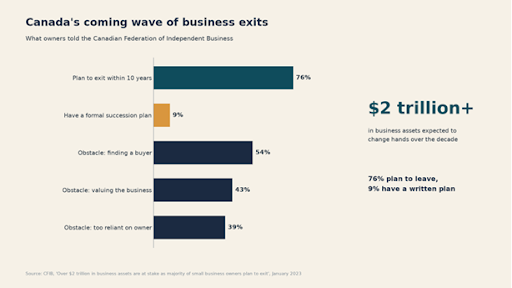
The scale of what is coming makes this urgent. The Canadian Federation of Independent Business reports that 76 percent of small business owners plan to exit within the next decade, with more than $2 trillion in business assets changing hands. Only 9 percent of them have a formal succession plan. The owners who have prepared will be selling into the same market as the ones who have not. The difference will show up in after-tax proceeds rather than in the headline price.
The Ownership Arrangement That Has to Exist Before Closing
For an incorporated owner or professional, the first question is whether an estate freeze makes sense. In a freeze, the owner exchanges common shares for fixed-value preferred shares and issues new common shares to a family trust or to the next generation. Future growth then accrues to them, while the owner keeps control and a known value for tax purposes. The mechanics are complicated enough that they belong with a tax lawyer and an accountant working from the same instructions. They also take months to implement cleanly.
For an executive with a large option or restricted stock grant, the structural question is different but no less urgent. Vesting schedules and exercise windows, together with any blackout periods, define when shares can actually be sold. Those dates should be mapped against the tax year before anything is exercised. A plan that spreads exercises across two calendar years can change the marginal rate on a large part of the proceeds, and for a partner the same logic applies to the timing of a capital account withdrawal.
The Concentration Problem Nobody Feels from the Inside
Executives and founders consistently underestimate how much risk arises in the company they know best. Lisa Meulbroek’s research in the Journal of Law and Economics estimated that employees who hold a quarter of their assets in company stock give up about 42 percent of that stock’s market value relative to holding a diversified portfolio. The reason is that they are bearing risk the market does not pay them for, and no view on the company’s prospects changes that arithmetic.
One Approach is a written diversification schedule, agreed in advance and executed on fixed dates as part of the family’s long-term allocation. It is a planning instrument rather than a market view, and it exists to establish and maintain a diversified portfolio that serves the family’s capital preservation and wealth transfer objectives. Founders who arrange a partial sale or a secondary transaction ahead of the main event reach that diversified position earlier. They also tend to negotiate the main event with a clearer head, because their family’s security no longer rides on it.
From a Career Asset to a Family Balance Sheet
The sudden transition from an illiquid career asset to liquid wealth is usually described as a windfall, and that is the wrong frame for the planning it requires. What actually arrives is a new layer of complexity that spans generations, entity structures, and often borders. Proceeds may sit in a holding company, a professional corporation, and a personal account at once. Children may already hold shares through trust. A cottage in another province or property in another country introduces a second tax regime. Wealth management at this stage is long-term strategic planning across all of those structures, and the investment portfolio is only one component of it.
That plan should be written before the money arrives. It should state what the proceeds are for, how much will be held in reserve for tax instalments, what the long-term asset mix will be, and how tax-optimized portfolio management will be applied across personal and corporate accounts. The corporate side needs particular care, and one CRA rule shows why. The agency begins reducing a private corporation’s small business limit once its passive investment income passes $50,000 a year, and the limit falls to nil at $150,000, so sale proceeds left to earn interest inside the company can quietly cost the operating business its preferred rate. Rules also change over time, and the federal government proposed raising the corporate capital gains inclusion rate to two-thirds in 2024, deferred it, and then canceled the increase in March 2025, which is exactly the kind of shift that changes what belongs in a corporate account and what belongs in a personal one. An asset location strategy that is not synchronized across that boundary produces compounding tax drag year after year, which is why maximizing after-tax outcomes must always be prioritized over raw headline investment returns.
Independent family offices, such as Tacita Capital, typically structure their frameworks around these principles, basing their value on independent ownership and focus on after-tax outcomes, and alignment with clients by managing the founding family’s own long-term wealth under the same strategy.
Assembling the Advisers in the Right Order
The final piece is who does the work, and the sequencing matters. The tax structure comes first, because everything else depends on it. The estate and trust documents that reflect the new ownership follow, and the investment plan for the proceeds comes last. Bringing the investment adviser lastly is common and usually a mistake. Asset location decisions and the timing of exercises interact with the tax plan in ways that are expensive to unwind.
The families who come out of a liquidity event best are the ones who treated the 18 months beforehand as the transaction itself. The closing is the last step of that process rather than the first. If a sale, a vesting cliff, or a partnership payout is somewhere on your horizon, the structural work has a deadline that is already closer than the deal.