7 Simple Ideas That Made Their Creators Millionaires

There may be some that began with an idea that might be expressed in one line: a rock in a box, a can of white paint, a word game. It is much more difficult to understand how these have been converted to wealth and who has kept it. Below are seven examples, labelled as such.
Which 7 Simple Ideas Made Their Creators Millions?
The figures behind these success stories are not directly comparable. Some refer to sales or profit, while others represent royalties, acquisition prices or estimated earnings. Here is what each financial term means:
- Sales (revenue): money customers paid, before costs.
- Profit: what was left after costs.
- Royalties: payments a creator receives for licensing an idea to another company.
- Sale price: what a buyer paid for the whole business or product.
- Net worth: a person’s total estimated wealth, including everything they own.
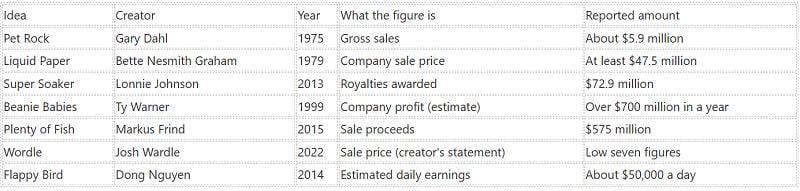
The examples were selected because the figures provided have a source attribution, and they range across tangible goods, an invention, a licensed toy, and three online instances. The table provides the number that headlines the example, while the text that follows outlines the way in which the revenue was earned:
Digital products can also build large audiences without charging users at the point of entry. Wordle was initially free, while Flappy Bird relied on advertising rather than an upfront purchase price. Similar acquisition models appear elsewhere in digital entertainment. In iGaming, for example, 25 free spins no deposit promotions may be offered to eligible new players without requiring an initial deposit. Their actual value depends on wagering requirements, expiry periods, withdrawal limits and other operator terms.
Pet Rock
Dahl sold ordinary stones as pets, each in a cardboard box with air holes and a joke care manual. At $3.95 each, about 1.5 million Pet Rocks were sold, which works out to roughly $5.9 million in sales. ABC News describes Dahl as a millionaire but does not give his profit. The humor matched a post-Watergate mood, and the craze had faded by 1976.
Liquid Paper
Graham, a secretary, mixed white tempera paint to match her office stationery and brushed it over typing errors. She sold it quietly to other secretaries and filled bottles in her garage, with her son helping for $1 an hour. In 1979, she sold the company to Gillette for at least $47.5 million. It was a simple fix, but it took 28 years to reach that deal.
Super Soaker
Johnson, an engineer with a background in fluid dynamics, licensed his water gun to Larami in 1989. Larami sold 27 million at $10 each in three years, and the line later passed 200 million units and about $1 billion in sales under Hasbro. Those are the toy’s sales, not Johnson’s pay. His own money came as royalties, and in 2013 an arbitrator awarded him $72.9 million after a dispute with Hasbro.
Beanie Babies
Beanie Babies were small plush animals priced at $5 or $10, sold through independent toy shops rather than big chains, with supply deliberately restricted to drive up demand. Around 1999, Ty Inc. is believed to have earned over $700 million in profit in a year. Forbes put Warner’s net worth at about $6.4 billion in March 2025, but that now includes hotels and resorts, so it is not a Beanie Baby number. The collector boom did not last.
Plenty of Fish
Frind built the dating site in about two weeks as a side project to learn ASP.NET, and ran it without venture capital. In 2008, he reported about $10 million in annual net profit while working roughly 10 hours a week. In 2015, Match Group paid $575 million in cash, and because Frind owned the whole company, he received the full amount. By then, the site had 90 million registered users.
Wordle
Wardle built Wordle as a gift for his partner and released it free in January 2021: one puzzle a day, no ads, no notifications, and a result you could share. It cost him about $100 a month to run, and by January 2022 it had more than 10 million daily players. The New York Times bought it for a low-seven-figure sum, Wardle said. The money came from the sale, since the game itself earned nothing.
Flappy Bird
Nguyen made the game over a holiday weekend in April 2013 and released it free in May with in-game ads. By February 2014, he was earning an estimated $50,000 a day after Apple’s and Google’s 30% cut, according to Rolling Stone. No total was published. On February,10, 2014, he pulled the game, saying he could not take the pressure.
What Do These Million-Dollar Ideas Have in Common?
Some patterns repeat, though no single one explains every case. Several of these ideas also came with a long wait, a legal fight, or a short window, so the paths looked very different from the concepts:
- A simple problem or desire: typing mistakes (Liquid Paper), a daily word puzzle (Wordle).
- Timing and mood: Pet Rock and Flappy Bird both caught a moment.
- Low production complexity: Wordle and Plenty of Fish were built by one person.
- Controlled supply: Beanie Babies limited what shops could sell.
- An unusual route to the money: royalties (Super Soaker) or a sale (Wordle, Plenty of Fish).
Simplicity was only part of the story. Bette Nesmith Graham spent nearly three decades building Liquid Paper before selling the company, while Lonnie Johnson later fought a legal battle over Super Soaker royalties. Pet Rock and Beanie Babies also show how quickly consumer crazes can fade. A simple idea may create an opportunity, but execution, timing, demand and the right business model determine whether it becomes commercially successful.