
America’s First Boardwalk Still Stretches Along the Jersey Shore
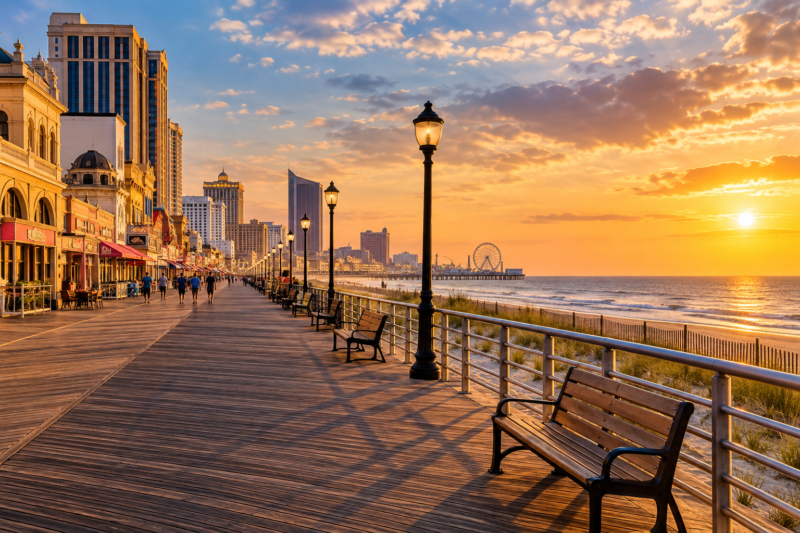
Each summer, thousands of locals and international visitors head to the Jersey Shore and walk the wooden planks of the Atlantic City Boardwalk. Few of them stop to think about the place as a piece of American history. As you and many others walk past the casinos, taffy shops, and the majestic Atlantic Ocean, the hands that built the 150+-year-old boardwalk probably never knew it would last this long.
What’s even more interesting than its age and the sights to see is the story behind the boardwalk’s creation. We’ll take a trip back in time to discuss that and also see what has changed over the last 150 years.
A simple fix to a sandy problem
Today, venues offering NJ casino games line part of the Boardwalk, but in the 1800s the bigger issue along the shore was sand. At the time, Atlantic City was gaining fame as a quick getaway for people who were tired of the bustling city life in Philadelphia and beyond. Once the railroad arrived in 1854, the trip to the coast became even easier and more fun for travelers. Plus, trains were also more affordable, which meant the number of visitors naturally increased. However, when it was time to go home, many of these guests brought half the beach with them, from sand stuck in their shoes to clothes.
Even the hotel lobbies were having a hard time staying clean, as everyone who walked in came with their own pile of sandy souvenirs. Among those who grew tired of the mess rapidly were Alexander Boardman, who worked as a railroad conductor, and Jacob Keim, who owned a local hotel.
Both men thought it’d be a sensible idea to create a raised wooden walkway so that people could still be by the beach and leave with clean soles and clothes. They proposed the idea to the city officials, and it was approved. That was how the first boardwalk was built and opened on June 26, 1870.
The first version was 8 feet wide and around a mile long, so we can say it was modest at best. They also made sure it was created in a way that allowed each section to be removed and stored once summer was over. Visitors loved it, and the sand problem was sorted, but that wasn’t the end.
The boardwalk got bigger and wider
The boardwalk became an attraction for even more visitors, which meant it needed to accommodate more people. As it gradually outgrew the original design, over the next quarter century, it was rebuilt and enlarged multiple times to help it keep up with the crowd. Each version became longer and wider than the last until wood couldn’t do the job anymore.
In 1896, the city decided to build a steel-framed version so it wouldn’t have to be packed up at the end of the season and could hold the crowd. That same year, Boardwalk was officially designated a city street, and commerce soon followed.
Shops, hotels, amusement piers, and restaurants began to spring up. The steady crowds made it an obvious place for business. The Steel Pier was the most famous of these entertainment venues because it brought big-name performers to the area.
By 1921, the Miss America competition began there, and tourists could now visit even past Labor Day. The famous Monopoly board game later took its street name from Atlantic City, and Boardwalk became the most valuable property in the game.
Rolling chairs became part of the Boardwalk itself
As the Boardwalk grew, it developed features that were not part of the original 1870 design. One of the most recognizable was the rolling chair. According to the Library of Congress, rolling chairs were introduced on the Boardwalk in 1884. They became so closely associated with Atlantic City that photographs from the early 1900s show rows of them moving past hotels and storefronts.
The city eventually adapted the Boardwalk around that traffic. A National Park Service study of New Jersey’s shore resorts notes that special runways for rolling chairs were added in 1914. Two years later, the city introduced the herringbone plank pattern that became another familiar part of the walkway’s appearance.
By then, the Boardwalk had become much more than a path designed to keep sand out of hotels. It was now the commercial heart of Atlantic City, lined with hotels and amusement piers.
Rolling chairs survived even as the city changed around them. Self-propelled versions began appearing in the 1940s, yet pushed chairs never fully disappeared. They remain visible on the Boardwalk today, more than a century after they first became part of the experience.
That continuity helps explain why the Boardwalk still feels different from an ordinary waterfront street. Its history is not only in the buildings around it, but also in the small traditions that have stayed in motion along the wooden planks.
When hard times hit, the community rebuilt
The Boardwalk’s history hasn’t always been smooth. Once the Second World War was over, people began to travel more by air and car, which meant they could access other vacation spots. Now hotels and other businesses struggled to keep the lights on as traffic to the area reduced. Then, in 1976, New Jersey voters approved casino gambling in Atlantic City as part of an effort to revive the local economy.
In 2012, Hurricane Sandy destroyed a section of the boardwalk in the city’s Inlet area, and the damaged stretches were later rebuilt. Today, the Boardwalk remains a living landmark on the Jersey Shore and has inspired other communities to build wooden promenades as well. For something designed to solve a single problem, it’s interesting to see how much it has meant to the people around it for more than 150 years.


