
Freight Forwarding for Small Businesses: Do You Really Need One?

Most small importers benefit from a freight forwarder once shipments become regular, high in value, or complex enough to trigger customs paperwork. The service coordinates carriers, consolidates documentation, and manages clearance so goods move across borders without costly delays. Businesses shipping only once or twice a year, in simple domestic lanes, can often manage the process on their own and skip the added coordination fee.
Introduction
A shipment sits at the port for a week while paperwork gets sorted, and demurrage charges climb by the day. For a small business importing goods for the first time, that scene is common and costly. Customs codes, carrier bookings, insurance certificates, and inland haulage each carry their own rules, and one error can hold an entire container. This is where many owners start asking whether a freight forwarder earns its fee.
The right answer depends on shipment volume, cargo value, and how far the goods travel. Companies importing on a regular basis often find that professional freight forwarding services pay for themselves through consolidated rates and fewer clearance delays. A business moving small, occasional loads within the country may see far less return. Volume and complexity decide where the line falls.
What a Freight Forwarder Does Behind the Scenes
A forwarder is not a carrier. The company does not own the ships or planes that move your cargo. Instead, it arranges space with those carriers, books the route, and manages the paperwork that surrounds every international shipment. Understanding what is a freight forwarder starts with that distinction, because the value sits in coordination rather than transport.
Coordinator, Not Carrier
Think of the role as a logistics general contractor. The forwarder sources capacity across ocean, air, and land, then stitches those legs into one door-to-door movement. A single container might travel by truck, ship, and truck again before arrival, and each handoff needs booking and tracking.
The Paperwork It Absorbs
Cross-border cargo generates a stack of documents. Commercial invoices, bills of lading, certificates of origin, and customs declarations each follow strict formats, and one wrong tariff code can stall a shipment for days.
- Customs entry filing and tariff classification
- Bills of lading and air waybills
- Cargo insurance certificates and claims support
- Dangerous goods declarations where the cargo requires them
- Import and export permits for regulated products
An international freight forwarder handles these filings daily, which is why an experienced provider clears paperwork faster than a first-time importer working alone. The result is fewer holds and less time lost at the border.
Freight Forwarder Services a Small Business Actually Uses
Not every offering matters to a company shipping a few pallets a month. The practical question is which services move the needle for smaller volumes, and where the break-even point sits. This is the detail most competing guides skip. They list features without telling you when the fee starts paying you back. The break-even table below gives the region’s small importers a clearer decision rule than the usual “it saves time and money” claim.
Core Freight Forwarder Services Worth Paying For
For most small importers, the useful bundle is narrow. Consolidation, where several small shipments share one container, turns an unaffordable full-container rate into a manageable shared one. Customs brokerage keeps goods moving. Cargo insurance protects the invoice value if something goes wrong in transit.
- Consolidation: shared container space for sub-container loads
- Customs brokerage: classification, entry, and duty calculation
- Cargo insurance: coverage against loss or damage in transit
- Documentation: end-to-end handling of the paper trail
The DIY Break-Even Point
Handling your own freight is realistic at low volume. The math shifts once shipments become frequent or high in value, because the hidden costs of errors, demurrage, and lost time start to outweigh the coordination fee.
Here is how the two approaches compare across the variables that matter to a small business.
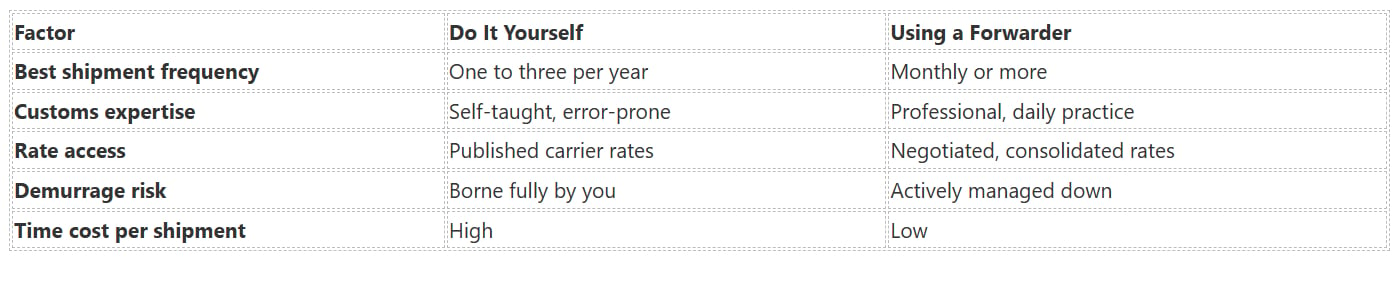 The table points to a clear threshold. Below roughly one container a quarter, self-management is defensible. Above it, the fee usually returns more than it costs.
Pro Tip: Before you commit, ask a prospective provider for a landed-cost estimate on a real past shipment. A precise quote that includes duties, port fees, and inland haulage tells you more about competence than any brochure, and it lets you compare the true cost against your current do-it-yourself total.
Choosing a Freight Forwarder Company for Long-Term Growth
Selecting a provider is a decision you will live with through every shipment. The right partner scales with your volume and stays transparent about cost. The wrong one adds a layer of confusion on top of already complex logistics. A few criteria separate the two.
What to Vet Before You Sign
Credentials and network reach tell you whether a provider can actually deliver on its promises. A forwarder with three decades of trade experience and a global agent network handles disruptions that a smaller broker cannot.


