How Much Does It Cost to Start a Used Car Dealership in 2026? Complete Startup Budget Breakdown
Starting a used car dealership requires significant capital investment across multiple areas of your business. The realistic minimum budget to launch a small independent used car dealership typically ranges from $150,000 to $400,000, though some operations may start with as little as $50,000 or require up to $899,000 depending on scale and location.
Your startup costs extend far beyond simply purchasing vehicle inventory. You need to account for licensing fees, real estate expenses, insurance coverage, staff wages, and digital marketing tools that help you compete in today’s market.
Understanding these essential startup costs before you commit to opening your dealership helps you avoid undercapitalization and financial setbacks.
This guide breaks down each cost category you’ll encounter when launching your used car dealership. From securing the proper legal documentation to building your initial inventory and establishing your online presence, you’ll learn what expenses to expect and how to plan your budget effectively for 2026.
Licensing and Legal Requirements
Starting a used car dealership requires navigating multiple regulatory layers, with dealer license costs ranging from a few hundred to over a thousand dollars plus mandatory bonding requirements. You’ll also need to budget for zoning permits, business registrations, and comprehensive insurance coverage to operate legally.
Dealer License Fees
Every state mandates that you obtain a dealer license before selling vehicles. The application fee varies significantly by location, typically ranging from $200 to $2,000 depending on your state’s requirements.
Beyond the initial license fee, you’ll need to secure a surety bond. Bond amounts differ by state but commonly fall between $10,000 and $100,000. The actual cost you pay for this bond is a percentage of the total amount, usually 1-15% annually based on your credit score and financial history.
Most states also require you to complete pre-licensing education or pass an examination. Some jurisdictions charge renewal fees every one to three years, which you should factor into your ongoing operational budget. You may also need separate licenses if you plan to sell different vehicle types or operate multiple locations.
Zoning and Business Permits
Your dealership location must comply with local zoning laws for commercial automotive sales. Zoning permit fees typically cost $100 to $500, though rezoning applications can run higher if your chosen property isn’t already approved for dealership use.
You’ll need a general business license from your city or county, usually costing $50 to $400 annually. Additional permits may include signage permits, environmental compliance certificates, and sales tax permits. Some municipalities require special use permits for outdoor vehicle display lots, which can add $200 to $1,000 to your startup costs.
Insurance Policies
Insurance represents a critical ongoing expense for protecting your dealership from liability and property damage. You’ll need multiple policy types to operate legally and protect your investment.
Required insurance policies typically include:
- General liability insurance: $1,000-$3,000 annually
- Garage keepers liability: $2,000-$5,000 annually
- Dealer’s open lot coverage: $3,000-$10,000 annually
- Workers’ compensation: Varies by employee count and state
- Property insurance: $1,500-$4,000 annually
Your actual insurance costs depend on your inventory value, number of employees, and coverage limits. Dealerships with higher-value inventory or multiple locations will pay significantly more for adequate protection.
Real Estate and Facility Costs
Real estate represents one of your largest upfront investments when starting a used car dealership, with location and facility expenses ranging from $50,000 to $150,000 depending on market conditions. Your choice between leasing and purchasing property, along with renovation needs and lot preparation, will significantly impact your initial capital requirements.
Leasing vs. Buying Property
Leasing commercial property offers lower upfront costs and greater flexibility for your dealership. Monthly lease payments typically range from $2,000 to $10,000 depending on your location, lot size, and local market rates.
You’ll need adequate space to display inventory, with most used car dealerships requiring 10,000 to 20,000 square feet of lot space. Urban locations command premium prices but provide higher foot traffic, while suburban or rural areas offer more affordable rates with potentially lower customer visibility.
Purchasing property requires substantially more capital but builds equity over time. You’ll need to secure commercial real estate financing, which typically requires 20-30% down payment plus closing costs. Property ownership gives you control over modifications and eliminates rent increases, but ties up significant capital that could otherwise fund inventory acquisition.
Facility Renovation and Signage
Your facility needs both functional workspace and professional appearance to attract customers. Budget $15,000 to $50,000 for basic renovations including office space, customer waiting areas, and restroom facilities.
Signage serves as your primary marketing tool and requires careful investment. Professional exterior signage costs between $5,000 and $15,000 depending on size, materials, and local permit requirements. You’ll also need interior displays, price tags, and informational materials.
Essential facility improvements include proper lighting for both the lot and showroom, paved surfaces for vehicle display, and climate-controlled office space. Your renovation budget should account for electrical work, plumbing, and any required building code compliance updates.
Security and Lot Preparation
Security systems protect your valuable inventory from theft and vandalism. A comprehensive security setup including cameras, motion sensors, and alarm systems costs $8,000 to $25,000 depending on lot size and equipment quality.
Lot preparation involves grading, paving, and drainage to create a professional vehicle display area. Paving costs range from $3 to $10 per square foot, meaning a 15,000 square foot lot requires $45,000 to $150,000 for proper surfacing.
You’ll need adequate fencing around the perimeter, which costs $15 to $40 per linear foot installed. Security lighting is essential for nighttime protection and typically adds $2,000 to $8,000 to your budget. Many dealerships also invest in gate systems with electronic access controls costing $3,000 to $10,000.
Inventory Acquisition Expenses
Inventory represents the largest single investment when starting a used car dealership, typically accounting for 50-70% of your total startup capital. Vehicle acquisition costs vary based on your sourcing methods, transportation needs, and the number of cars you plan to stock initially.
Sourcing Used Vehicles
You’ll acquire inventory through several channels, each with different cost structures. Wholesale auctions remain the most common source, where you can purchase vehicles at $2,000 to $15,000 below retail value depending on make, model, and condition.
Trade-ins from customers offer another avenue once you’re operational, though this requires established relationships and working capital. Private party purchases allow you to negotiate directly with sellers, often securing better margins than auctions but requiring more time per vehicle.
Dealer-to-dealer transactions provide quick inventory turnover opportunities. You’ll need an auction membership costing $200-$600 annually, plus buyer fees of $100-$300 per vehicle purchased. Bank repossessions and fleet sales offer bulk purchasing options at competitive rates, though these typically require stronger cash positions.
Transportation and Delivery
Moving vehicles from acquisition points to your lot adds $150-$500 per car depending on distance. Local pickups within 50 miles typically cost $150-$250, while cross-state transport ranges from $300-$500.
You can reduce these costs by driving vehicles yourself when feasible. However, you’ll need proper dealer plates and insurance coverage, which costs $500-$1,500 annually. Transport companies offer volume discounts if you’re moving multiple vehicles simultaneously.
Factor in inspection costs before transport, as mechanical issues discovered during delivery can complicate the process. Some auction houses include limited delivery services in their fee structure.
Initial Inventory Size
Small used car dealerships typically start with 10-20 vehicles, requiring $100,000-$300,000 in inventory capital. Your per-vehicle investment depends on your target market segment.
Budget-focused lots stock vehicles at $5,000-$10,000 each, while mid-range dealerships carry inventory valued at $12,000-$20,000 per unit. Premium used car operations may invest $25,000-$40,000 per vehicle for late-model, low-mileage stock.
You need adequate variety to attract buyers without overextending your capital. Most successful startups maintain a 60-day inventory turnover target, meaning your initial stock should represent approximately two months of projected sales volume.
Staffing and Payroll Considerations
Building a competent team requires careful budget planning for salaries, benefits, and ongoing training. Personnel costs typically represent your largest fixed expense after inventory, with base payroll starting around $49,167 monthly for 7 full-time employees at a standard dealership.
Hiring Sales and Administrative Staff
You need to assemble a core team that includes salespeople, a finance manager, and administrative support. For a small used car dealership, you can start with 2-3 sales staff earning $30,000-$50,000 base salary plus commission structures of 20-25% of gross profit per vehicle sold.
A finance and insurance manager typically commands $45,000-$75,000 annually since they handle loan arrangements and extended warranty sales. Administrative staff for title work, customer service, and lot management usually earn $28,000-$40,000 per year.
Your dealership operates as a people-driven business, making staff quality directly impact sales performance. You should budget for higher salaries in competitive markets where experienced automotive sales professionals have multiple employment options.
Training and Certification
Sales staff need product knowledge training, CRM system familiarity, and compliance education on fair lending practices and disclosure requirements. Initial training costs range from $500-$1,500 per employee for comprehensive onboarding programs.
Your finance manager requires state-specific licensing for selling vehicle service contracts and insurance products. These certifications cost $200-$800 depending on your location and typically require renewal every 2-3 years.
Ongoing training for inventory management software, digital retailing platforms, and customer relationship tools adds $100-$300 per employee annually. You should factor in 20-40 hours of paid training time during the first 90 days for new hires.
Employee Benefits
Basic benefit packages including health insurance, paid time off, and retirement contributions add 20-30% to base salary costs. For a $40,000 annual salary, you should budget an additional $8,000-$12,000 for benefits.
Workers’ compensation insurance for dealership employees costs approximately 1-3% of total payroll depending on your state and claims history. Unemployment insurance adds another 2-6% of wages in most states.
Commission-based compensation reduces fixed costs but requires careful structuring to maintain motivation during slow sales periods. Many dealerships offer small draw amounts of $2,000-$3,000 monthly against future commissions to provide income stability for sales staff.
Marketing and Digital Presence
Building visibility for your dealership requires investment in both digital infrastructure and local market presence, with initial costs typically ranging from $5,000 to $25,000 depending on your market size and competition level.
Website Development and Hosting
Your website serves as your digital showroom and requires professional development to compete effectively. A custom dealership website with inventory management integration costs between $3,000 and $10,000 for initial development. Template-based solutions start around $1,500 but offer less flexibility.
Monthly hosting and maintenance fees range from $50 to $300 depending on your traffic volume and feature requirements. You’ll need inventory management software integration, which costs $100 to $500 monthly depending on the platform. Photography equipment or professional photography services add another $500 to $2,000 to capture quality vehicle images.
Essential Website Features:
- Mobile-responsive design
- Vehicle inventory search and filters
- Financing calculator tools
- Lead capture forms
- Click-to-call functionality
Most dealerships allocate $200 to $500 monthly for ongoing updates, security patches, and content management.
Online Advertising Budgets
Digital advertising costs have increased as buyers begin their car search online and compare options quickly. Your initial advertising budget should range from $1,000 to $5,000 monthly depending on your market size.
Google Ads campaigns for used car dealerships typically cost $2 to $8 per click in competitive markets. Facebook and Instagram advertising runs $500 to $2,000 monthly for effective reach. You’ll also need listing fees for platforms like CarGurus, Autotrader, and Cars.com, which range from $300 to $1,500 monthly per platform.
Budget an additional $500 to $1,500 for email marketing software, customer relationship management tools, and social media management platforms during your first year.
Local Branding Initiatives
Physical signage remains crucial for attracting drive-by traffic to your lot. Monument signs and building signage cost $3,000 to $15,000 depending on size, materials, and local permit requirements. Vehicle wraps for your service or delivery vehicles range from $2,500 to $5,000 per vehicle.
Local print advertising in newspapers and community publications costs $200 to $1,000 monthly. Direct mail campaigns to targeted neighborhoods run $500 to $2,000 per campaign depending on volume and design complexity.
You should also budget $1,000 to $3,000 for branded materials including business cards, brochures, banners, and promotional items. Community sponsorships and local event participation typically require $1,000 to $5,000 annually but build strong neighborhood presence.
Operational and Administrative Costs
Beyond inventory and physical space, running a used car dealership requires essential office infrastructure and technology systems. These operational expenses typically range from $15,000 to $50,000 in initial setup costs, with ongoing monthly expenses that keep your business functioning efficiently.
Office Equipment and Supplies
Your dealership needs basic office equipment to handle daily operations and customer transactions. You’ll need computers, printers, phones, desks, chairs, and filing cabinets for your sales and administrative staff.
Budget between $8,000 and $20,000 for initial office equipment purchases. This includes 3-5 workstations with computers ($3,000-$5,000), multifunction printers ($500-$1,500), and phone systems ($1,000-$3,000).
Office supplies like paper, business cards, vehicle tags, and documentation materials cost $200-$500 monthly. You’ll also need customer waiting area furniture, which can add another $2,000-$5,000 depending on your dealership size. Don’t overlook security systems including cameras and alarms, which typically cost $2,000-$4,000 for installation plus monthly monitoring fees of $50-$150.
Software and Management Systems
Modern dealership software streamlines inventory tracking, customer relationship management, and compliance reporting. Dealership management systems are essential for tracking vehicle history, pricing, and sales documentation.
Expect to pay $200-$800 monthly for comprehensive dealer management software. These platforms handle inventory management, customer databases, financing calculations, and state-required reporting. Accounting software adds another $30-$100 monthly, while website hosting and maintenance costs $50-$300 monthly.
You’ll also need vehicle history report subscriptions like CARFAX or AutoCheck, costing $500-$1,500 monthly depending on volume. Digital marketing tools and customer communication platforms add $100-$400 monthly to your operational budget.
Compliance and Regulatory Fees
Beyond licensing and bonding, you’ll face ongoing expenses tied to environmental compliance and mandatory reporting requirements. These costs vary by state but remain essential for maintaining your dealership’s legal standing.
Environmental Regulations
Used car dealerships must comply with EPA Clean Air Act standards and proper disposal protocols for hazardous materials. You’ll need to establish systems for handling used motor oil, transmission fluid, antifreeze, and other automotive fluids according to federal and state guidelines.
Most states require you to partner with licensed waste disposal services, which typically cost between $100 to $300 monthly depending on your inventory turnover. You may also need to install oil-water separators or other environmental management equipment on your lot, with initial installation ranging from $2,000 to $8,000.
Air quality compliance extends to vehicles sold in your state. Some regions require emissions testing facilities on-site or partnerships with certified testing centers. Factor in $50 to $150 per vehicle for emissions compliance in states with strict requirements.
State and Federal Reporting
Your dealership must file regular reports with your state motor vehicle department and potentially the IRS. State dealer licenses require compliance with specific reporting deadlines and formats that vary by jurisdiction.
You’ll need to report every vehicle sale, including odometer disclosures, title transfers, and sales tax collection. Most dealerships invest in dealer management software to handle these requirements, costing $100 to $500 monthly. Some states charge per-transaction fees ranging from $5 to $25 for electronic title submissions.
Federal reporting includes IRS Form 8300 for cash transactions over $10,000 and maintaining records for FTC Used Car Rule compliance. Budget $1,000 to $3,000 annually for accounting services that specialize in dealership reporting requirements.
Ongoing and Unforeseen Expenses
Beyond startup costs, a used car dealership requires consistent cash flow to cover recurring operational expenses and unexpected challenges. Monthly fixed costs combined with emergency reserves form the backbone of sustainable operations.
Utilities and Maintenance
Your dealership will incur monthly running costs around $74,000, which includes $25,100 in fixed overhead covering lease, software, and utilities. Electricity for lighting your lot and showroom typically ranges from $800 to $2,500 monthly depending on your facility size and operating hours.
Water, internet, phone systems, and security monitoring add another $500 to $1,200 per month to your overhead. Regular maintenance expenses include lot cleaning, landscaping, snow removal in winter climates, and general facility upkeep. You’ll need to budget for HVAC servicing, parking lot repairs, and sign maintenance.
Vehicle detailing supplies, repair tools, and diagnostic equipment require ongoing replenishment. Computer systems, dealer management software subscriptions, and inventory listing platforms generate recurring technology costs between $1,000 and $3,000 monthly.
Contingency Funds
Preparing for unexpected costs requires constant monitoring to ensure healthy cash flow throughout your operations. You should maintain a contingency reserve of 10-15% of your total startup capital for unforeseen circumstances.
Emergency repairs to facility systems, unexpected regulatory compliance requirements, or legal disputes can arise without warning. Vehicle warranty claims, return disputes, and delayed title processing create financial pressures that demand immediate attention.
Market fluctuations affecting vehicle values, sudden changes in lending requirements, or economic downturns impact your inventory equity and sales velocity. A reserve fund covering three to six months of operating expenses provides essential stability during slow periods or unexpected market disruptions.
Financial Planning and Funding Sources
Securing adequate financing requires understanding both traditional and alternative funding channels, while strategic budget allocation ensures your capital covers critical startup expenses without overextending resources. Most dealerships need a combination of funding sources to reach the minimum $150,000 to $400,000 investment threshold.
Startup Capital Options
You can access multiple funding avenues to launch your dealership. Personal savings and owner equity typically form the foundation, demonstrating commitment to potential lenders and partners.
Traditional bank loans remain a primary option, though lenders usually require strong credit scores and collateral. Floor plan financing specifically addresses inventory needs by allowing you to purchase vehicles without immediate full payment, paying interest only until each vehicle sells.
The Small Business Administration offers SBA loans with favorable terms for qualified applicants. Business lines of credit provide flexible working capital for ongoing expenses. You might also consider bringing in investors or partners who contribute capital in exchange for ownership stakes.
Equipment financing helps spread the cost of diagnostic tools, lifts, and other necessary machinery. Some dealers explore specialized debt structures for inventory and assets that separate vehicle acquisition from operational expenses.
Budget Allocation Strategies
Your largest allocation goes toward inventory, typically consuming 50-70% of total startup capital. You need sufficient vehicles to attract customers while maintaining quality standards.
Real estate costs demand 15-25% of your budget, whether leasing or purchasing property. This includes lot improvements, signage, and customer parking areas.
Reserve 10-15% for licensing, permits, bonds, and insurance requirements. Dealer bonds alone cost $10,000-$50,000 depending on your state.
Set aside 5-10% for initial marketing, website development, and advertising to generate customer traffic from day one. Maintain a working capital reserve of 3-6 months operating expenses to cover payroll, utilities, and unexpected costs before revenue stabilizes.
Summary of Estimated Startup Costs
Starting a used car dealership requires substantial capital investment. The total startup cost typically ranges from $100,000 to $500,000, with an average investment around $275,000.
Your costs will vary based on several factors including location, dealership size, and inventory volume. Smaller operations may start with as little as $50,000, while larger full-service lots can exceed $500,000.
Major Cost Categories
Here’s what you need to budget for:
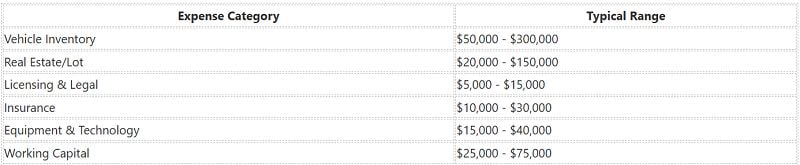
Inventory acquisition represents your largest expense, followed by real estate costs and working capital for the first six months. The minimum total cash required can reach $899,000 when including comprehensive inventory and initial overhead expenses.
Initial capital expenditures for fixed assets, including lot improvements and service equipment, total approximately $232,000 before operational costs begin. You’ll need additional funds for marketing, staff salaries, utilities, and unforeseen expenses during your launch phase.
Your specific startup costs depend on your business model and market positioning. A transparent, quality-focused dealership requires different investments than a high-volume operation.