How Poor Forklift Servicing Leads to Expensive Downtime
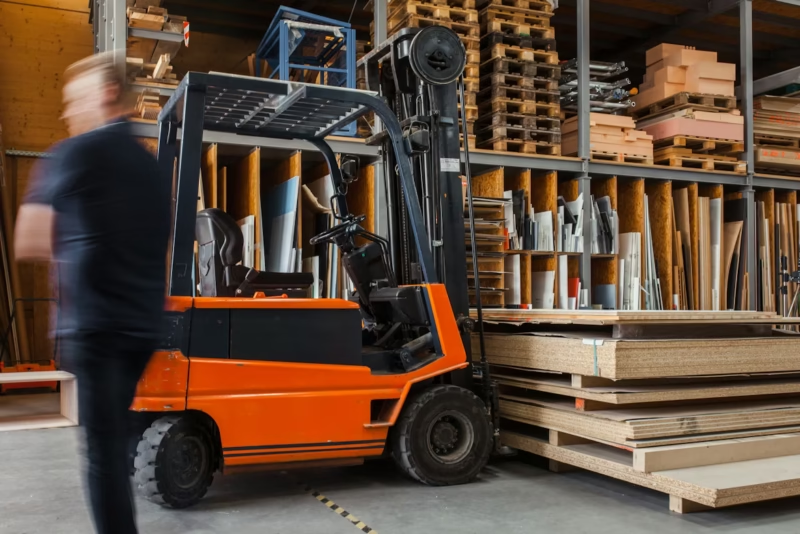
Downtime in a warehouse rarely starts with a dramatic breakdown. More often, it begins quietly: a forklift that hesitates when lifting, a warning light that “sometimes” appears, a slight shudder under load, a mast that feels a bit sluggish on cold mornings. These small signs are easy to rationalize when you’re trying to hit shipping targets. But they’re also the early chapters of a story that ends with missed dispatch windows, reshuffled labor, and an unexpected repair bill.
Forklifts sit at the center of most material-handling operations. When they stop, everything downstream gets noisy and expensive, especially in facilities that run tight pick/pack cycles or just-in-time replenishment. Poor servicing doesn’t just increase the chance of failure; it increases the cost of failure by making the breakdown harder to predict, harder to diagnose, and harder to fix quickly.
The hidden mechanics of downtime: why “minor” issues become major stoppages
A forklift is a system of systems: hydraulics, electrics, drivetrain, brakes, steering, and safety interlocks. If routine servicing is skipped or rushed, components don’t simply wear out faster, they often fail in ways that create cascading problems.
Wear doesn’t stay contained
Consider something as unglamorous as a hydraulic hose. If inspections are sporadic, you might miss abrasion, swelling, or early cracks near fittings. A hose failure is rarely just a hose replacement. It can:
- Dump fluid onto the floor (clean-up time, slip hazards, environmental handling)
- Starve the pump (risking pump damage)
- Pull the truck out of service pending a full inspection and pressure test
The same pattern shows up elsewhere. A neglected air filter can accelerate engine wear. Poor battery maintenance can shorten battery life and create intermittent electrical faults. Worn chains or mast rollers can shift loads unevenly and increase stress on the mast assembly.
Intermittent faults are the most expensive faults
One of the biggest costs of poor servicing is diagnostic time. A forklift that “cuts out occasionally” is far more disruptive than one that fails decisively. Intermittent issues eat maintenance hours and create operational uncertainty: do you assign that truck to a heavy lift, or keep it on light duties? Do you rotate drivers? Do you plan around it, or gamble?
This is where a disciplined servicing approach pays for itself. Documented inspections, trend tracking (battery health, hydraulic pressures, brake wear), and timely part replacement reduce the odds of mystery faults because fewer components are operating in the grey zone.
The real cost of downtime: it’s not just the repair invoice
Most teams can estimate the repair cost. What’s harder to quantify but usually larger is the operational ripple effect.
Labor inefficiency and workflow congestion
When a forklift goes down mid-shift, the work doesn’t disappear. It piles up. People start waiting: pickers waiting for replenishment, loaders waiting for pallets, supervisors juggling priorities. If you hire temporary equipment or reassign another truck, you often create new bottlenecks elsewhere.
Even short downtime can be expensive in high-throughput environments. If a truck is central to a narrow-aisle operation or a particular attachment task (paper clamp, rotator, carton clamp), substitution isn’t simple. The result is either reduced output or compromised process discipline—both of which show up in quality and safety metrics.
Knock-on safety risks
Poor servicing doesn’t just stop trucks; it changes behavior. Operators under pressure may push marginal equipment harder, take sharper turns to make up time, or ignore early warning signs. That’s when “downtime risk” becomes “incident risk.”
If you’re seeing recurring issues, brakes needing frequent adjustment, steering play, inconsistent lift/tilt response, it’s worth treating this as a servicing strategy gap rather than a run of bad luck. In many operations, bringing in professional forklift repair services for a structured maintenance approach can help convert reactive fixes into planned interventions, which is where downtime starts to shrink.
Where poor servicing typically goes wrong (and how to spot it early)
The difference between a robust servicing program and a fragile one usually comes down to consistency, documentation, and realism about usage.
“Calendar servicing” without usage context
A truck working one gentle shift a day does not age like a truck running two shifts in a dusty yard with heavy loads. Servicing schedules need to reflect:
- Operating hours (not just months)
- Load intensity and lift height frequency
- Environment (dust, cold, wet, corrosive air)
- Operator patterns (multiple drivers, impact history)
If you’re seeing repeated wear in specific areas, tires, brakes, mast components, it’s often a sign the servicing interval doesn’t match reality, or that operating conditions have changed.
Missed basics: batteries, tires, and lubrication
Not every failure is exotic. Some of the most common downtime triggers are also the most preventable:
- Batteries (electric trucks): poor watering practices, dirty terminals, undercharging/overcharging, heat stress
- Tires: underinflation (pneumatics), chunking, uneven wear from misalignment or harsh turns
- Lubrication: dry mast channels, neglected pivot points, contaminated grease points
These “basics” affect performance long before they cause a hard stop. The trick is to treat them as leading indicators. If battery run time is shrinking, you don’t just need a fresh battery, you need to know why it’s shrinking.
Paperwork that doesn’t help anyone
A service checklist that gets ticked without meaningful notes is little better than nothing. Useful documentation should tell a story over time: recurring fault codes, parts replaced, measurements taken, advisories issued, and whether those advisories were actioned. When documentation is thin, decisions get delayed, and delayed decisions become downtime.
Practical ways to reduce downtime without overhauling everything
You don’t need a perfectly engineered maintenance utopia to see results. A few grounded changes can dramatically improve uptime.
1. Treat pre-use checks as data, not compliance
Operator checks are often framed as a legal requirement (which they are), but their real value is early detection. Encourage operators to report small changes, noises, vibration, steering feel, without fear of being blamed for “complaining.” The earlier you catch a deviation, the easier it is to plan a fix.
2. Use planned downtime to avoid unplanned downtime
If a truck is due tires, brakes, and a hydraulic service, doing them separately across three call-outs is disruptive and inefficient. Bundling work into a scheduled service window reduces repeated stoppages and makes parts planning easier.
3. Keep a short list of high-impact spares
You don’t need a full parts room, but it’s sensible to stock a few items that frequently stop trucks and are slow to source. The right list depends on your fleet, but think in terms of “stop-the-world” components: fuses, common sensors, contactors (electric), key hydraulic hoses, and a tire plan that doesn’t rely on next-day miracles.
4. Track the right metrics
Instead of only tracking repair spend, track:
- Mean time between failures (MTBF)
- Repeat faults by truck/shift
- Downtime hours per month (planned vs unplanned)
- Response time to advisories
These metrics reveal whether you’re improving reliability or just getting faster at firefighting.
The bottom line: poor servicing makes downtime longer, costlier, and harder to predict
A forklift breakdown is rarely a single bad moment. It’s usually the final outcome of dozens of small decisions: postponing a service, ignoring an advisory, running a battery too low, or treating intermittent faults as “just one of those things.” The cost shows up in delayed loads, wasted labor, and avoidable safety exposure.
If you want less downtime, focus on predictability. Consistent servicing, meaningful records, and early intervention won’t eliminate every failure, but they will turn chaotic stoppages into planned maintenance. And in a busy operation, predictability is what keeps the floor moving.