Tesla Model Y vs Lexus RX 350: A Comprehensive Family SUV Comparison
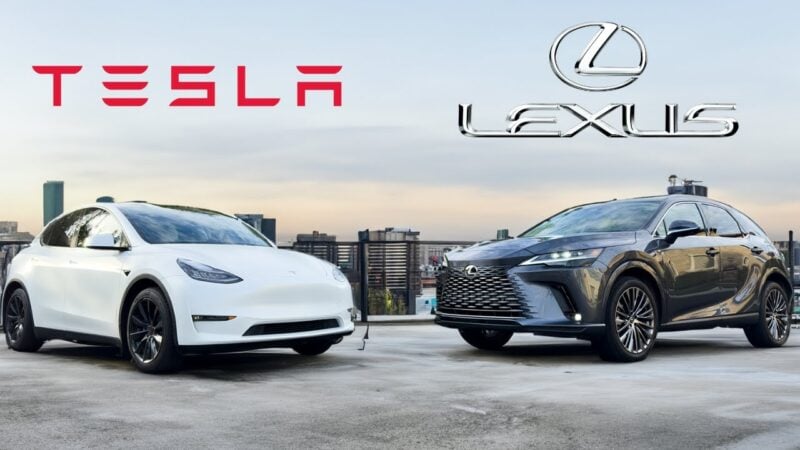
Choosing between the Tesla Model Y and Lexus RX 350 comes down to whether your family prioritizes electric efficiency and cutting-edge technology or proven luxury craftsmanship and traditional comfort.
The 2025 Tesla Model Y starts at $64,990, while the Lexus RX 350 begins at $60,230, positioning both as premium family SUVs with distinct philosophies.
The Tesla Model Y offers superior long-term cost savings through zero fuel costs and minimal maintenance, while the Lexus RX 350 delivers a quieter cabin, more refined ride quality, and the reassurance of traditional automotive engineering.
Your decision will depend on which combination of factors matters most for your family’s daily needs and budget. Both vehicles provide over 140 data points worth comparing, from interior space and safety features to technology systems and real-world ownership costs.
Understanding how these SUVs perform in areas that directly impact family life will help you make the right choice for your household.
Family Comfort and Interior Space
The Tesla Model Y offers seating for up to seven passengers with an optional third row, while the Lexus RX 350 seats five in a more traditional luxury SUV layout. Both vehicles prioritize passenger comfort but take different approaches to interior materials and cargo flexibility.
Seating Configurations and Passenger Room
The Model Y comes standard with five seats, but you can add a third row for two additional passengers. This third row works best for children due to limited headroom and legroom. The front seats provide 41.8 inches of legroom, while second-row passengers get 40.5 inches.
The Lexus RX 350 focuses on five-passenger seating with generous space across both rows. Front occupants enjoy 44.1 inches of legroom, and second-row passengers receive 38 inches. The RX 350 offers wider seats and more shoulder room at 57.6 inches in the front compared to the Model Y’s 56.4 inches.
Both vehicles feature heated front seats as standard equipment. The RX 350 includes power-adjustable front seats with memory settings, while the Model Y uses manual adjustments for some seat functions.
Cargo Volume and Storage Flexibility
The Model Y provides 76 cubic feet of cargo space with seats folded and 30.2 cubic feet behind the second row. It includes a front trunk that adds 4.1 cubic feet of additional storage space. The flat load floor and wide opening make loading large items straightforward.
The Lexus RX 350 offers 46.2 cubic feet with the rear seats down and 29.6 cubic feet behind the second row. The power liftgate opens to a well-finished cargo area with tie-down hooks and underfloor storage compartments. The RX 350’s higher ride height requires lifting items slightly higher than in the Model Y.
The Model Y’s rear seats fold completely flat, creating a more versatile cargo area for camping or hauling equipment.
Interior Materials and Build Quality
The RX 350 features leather upholstery, wood trim, and soft-touch surfaces throughout the cabin. The interior design emphasizes traditional luxury with physical buttons and knobs for climate controls. Panel gaps remain tight, and materials feel substantial to the touch.
The Model Y uses synthetic leather seats and a minimalist design centered around a 15-inch touchscreen. Interior materials include hard plastics on the doors and dashboard, though fit and finish have improved in recent production years. The glass roof comes standard and creates an open feeling for passengers.
Both vehicles offer dual-zone climate control, though the Lexus provides more intuitive physical controls while Tesla requires navigating the touchscreen for most adjustments.
Safety Ratings and Family-Oriented Features
The Tesla Model Y holds a distinct advantage in crash testing, while both SUVs offer comprehensive safety technology packages designed to protect families on the road.
Crash Test Scores and Safety Awards
The Tesla Model Y earned the IIHS Top Safety Pick+ designation, making it the only midsize or larger electric SUV to achieve this highest honor. The Model Y received the top “Good” rating in every crash and crash avoidance test administered by the IIHS.
IIHS testing shows the Model Y performed well in both driver-side and passenger-side small overlap front evaluations for model years 2020-2025. This comprehensive testing demonstrates strong occupant protection in various collision scenarios.
The Lexus RX 350 has not received the same Top Safety Pick+ designation, though it performs adequately in standard crash tests. Lexus vehicles typically score well in federal safety testing, but the RX 350 lacks the distinguished awards that the Model Y has accumulated.
Active Safety Technologies
Both SUVs come equipped with advanced driver assistance systems as standard equipment. The Tesla Model Y includes Autopilot with features like automatic emergency braking, lane keeping assist, and adaptive cruise control built into every model.
The Lexus RX 350 features the Lexus Safety System+ 3.0, which includes pre-collision warning with pedestrian detection, dynamic radar cruise control, lane departure alert, and lane tracing assist. You’ll also find road sign assist and automatic high beams as standard equipment.
Tesla’s system offers more advanced semi-autonomous capabilities through its Autopilot and optional Full Self-Driving package. The Lexus system focuses on traditional driver assistance features with a more conservative approach to automation.
Child Seat Accommodation
The Model Y provides three LATCH positions across the second row, allowing you to install up to three child seats simultaneously. The rear seats fold flat in a 60/40 split configuration, and you’ll find the LATCH anchors easily accessible.
The Lexus RX 350 also offers LATCH positions for three child seats in the second row. The wider cabin gives you slightly more space between car seats when installing multiple units side by side. Both vehicles accommodate rear-facing infant seats without requiring the front passenger seat to move significantly forward.
Ride Quality and Driving Experience
The Tesla Model Y delivers instant electric power with a firm, performance-oriented suspension, while the Lexus RX 350 prioritizes smooth, cushioned comfort with its traditional luxury setup. Your daily driving experience will differ significantly between these two approaches to SUV design.
Handling and Suspension
The Model Y uses a sport-tuned suspension that keeps the vehicle flat through corners, thanks to its low center of gravity from the battery pack placement. You’ll feel more road feedback and a connected driving experience, though some passengers may find the ride stiff over rough pavement.
The RX 350 features a suspension calibrated for comfort rather than sporty handling. You’ll notice how well it absorbs bumps and road imperfections, making it feel more isolated from the road surface. The trade-off comes in body roll during aggressive cornering, though this rarely matters for typical family driving scenarios.
Weight distribution plays a key role in how these vehicles handle. The Model Y’s battery placement creates a balanced 50/50 distribution, while the RX 350 carries more weight toward the front with its engine position.
Cabin Noise Levels
The Model Y benefits from having no engine noise, creating a quiet cabin at low speeds. Wind noise becomes more noticeable at highway speeds due to the frameless windows, and road noise from the tires can intrude on certain surfaces. Tesla has improved sound insulation in recent production years.
Lexus built its reputation on refinement, and the RX 350 demonstrates superior noise isolation across most driving conditions. You’ll experience less wind rush and tire roar even at 70 mph. The engine remains muted during acceleration, and Lexus includes acoustic glass in key areas.
Performance in City and Highway Driving
The Model Y accelerates from 0-60 mph in approximately 4.8 seconds with the Long Range variant, providing immediate throttle response that makes merging and passing effortless. Regenerative braking allows one-pedal driving in city traffic, reducing brake wear and enhancing efficiency.
Your RX 350 takes about 7.4 seconds to reach 60 mph, which feels adequate but not exciting. The eight-speed transmission shifts smoothly, and the 2.4-liter turbocharged engine provides sufficient power for highway passing. Fuel economy reaches around 22 mpg city and 29 mpg highway.
In stop-and-go traffic, you’ll appreciate the Model Y’s ability to creep forward without touching pedals and its Autopilot features for reducing driver fatigue. The RX 350 counters with a more predictable brake pedal feel and smoother low-speed transitions.
Technology and In-Car Entertainment
The Tesla Model Y delivers a minimalist tech experience centered around a 15-inch touchscreen, while the Lexus RX 350 offers a more traditional luxury approach with physical controls and an available 14-inch display. Your choice depends on whether you prefer cutting-edge software features or refined conventional systems.
Infotainment System Comparison
The Tesla Model Y features a 15-inch central touchscreen that controls nearly all vehicle functions. You’ll find no traditional instrument cluster behind the steering wheel. Instead, all driving information appears on the main screen’s left side.
Tesla’s system runs on proprietary software that receives over-the-air updates, adding new features and improvements without dealer visits. The interface includes navigation with real-time traffic, streaming services like Spotify and Netflix, and web browsing capabilities. You can also play games when parked.
The Lexus RX 350 uses the Lexus Interface system with an available 14-inch touchscreen. You get both touch controls and a physical touchpad on the center console. The dual-control approach gives you options that some drivers find more intuitive while driving.
Lexus includes wireless Apple CarPlay and Android Auto as standard features. The system also provides voice recognition, though it’s not as advanced as Tesla’s voice commands.
Connectivity and Convenience Features
Both SUVs offer wireless smartphone charging and multiple USB ports. The Model Y includes four USB-C ports throughout the cabin, while the RX 350 provides a mix of USB-A and USB-C connections.
Tesla’s connectivity shines with its built-in LTE connection that requires no separate subscription for basic features. You get premium connectivity features like live traffic visualization and satellite maps for $9.99 monthly. The vehicle’s app lets you precondition the cabin, check charging status, and even summon the car from tight parking spaces.
The Lexus RX 350 includes a one-year trial of Lexus Enform services. You can remotely start the engine, lock or unlock doors, and locate your vehicle through the smartphone app. After the trial period, these services require a subscription.
Key connectivity differences:
- Tesla offers a premium audio system with 13 speakers standard
- Lexus provides an available Mark Levinson audio system with 21 speakers
- Tesla integrates dashcam and sentry mode using built-in cameras
- Lexus includes Amazon Alexa integration for smart home control
Efficiency, Powertrains, and Cost of Ownership
The Model Y runs on electric power with 295 horsepower, while the RX 350’s base engine produces 275 horsepower from a traditional gasoline powertrain. Long-term expenses differ significantly between these vehicles due to fuel costs, maintenance schedules, and depreciation rates.
Fuel Economy vs Range
The Tesla Model Y operates purely on electricity, eliminating gas station visits entirely. You’ll spend significantly less on energy compared to filling up the RX 350’s gas tank regularly. The Model Y offers an EPA-estimated range between 260 to 330 miles depending on the configuration you choose.
The Lexus RX 350 delivers around 22-29 mpg combined, requiring premium gasoline for optimal performance. You’ll face fluctuating fuel prices that can impact your monthly budget. Over 100,000 miles, the cost difference between electric charging and gasoline becomes substantial.
Charging at home overnight costs less than public charging stations, while the RX 350 offers the convenience of quick five-minute refueling stops. Your driving patterns and access to charging infrastructure will determine which approach fits your lifestyle better.
Maintenance Requirements and Reliability
The Model Y requires minimal scheduled maintenance since electric motors have fewer moving parts than combustion engines. You won’t need oil changes, transmission services, or exhaust system repairs. Brake pads last longer due to regenerative braking technology that captures energy during deceleration.
The RX 350 follows traditional maintenance schedules including oil changes every 5,000-10,000 miles, transmission fluid replacements, and spark plug changes. Lexus builds a strong reputation for reliability, but the cost of ownership over 100,000 miles runs higher than the Model Y when factoring in all maintenance and repair expenses.
Tesla’s warranty covers the battery and drive unit for 8 years or 120,000 miles. Lexus provides a 4-year/50,000-mile basic warranty with powertrain coverage extending to 6 years/70,000 miles.
Charging Accessibility vs Refueling Ease
You can charge the Model Y at home with a standard 120V outlet or install a 240V wall connector for faster charging speeds. Tesla’s Supercharger network spans major highways and urban areas, providing 15-30 minute charging sessions on road trips. Public charging stations continue expanding but remain less common than gas stations in rural areas.
The RX 350 refuels at any gas station within minutes, offering unmatched convenience for spontaneous trips. You won’t need to plan routes around charging infrastructure or wait for battery replenishment. Gas stations operate 24/7 in most locations without requiring apps or membership accounts.
Home charging makes the Model Y more convenient for daily commuting since you start each morning with a full battery. Your home electrical system may need upgrades to support faster charging rates.
Budget Considerations and Value
The Tesla Model Y typically starts around $44,000 for the base rear-wheel drive model, while the Lexus RX 350 begins at approximately $50,000. Long-term ownership costs reveal significant differences, with the Model Y potentially saving you thousands over 100,000 miles.
Pricing and Trim Options
The Model Y offers fewer trim levels than the RX 350, with three main configurations: Long Range, Performance, and the base model. Prices range from roughly $44,000 to $54,000 depending on the variant you choose. The Long Range version extends to approximately $48,000 and includes all-wheel drive as standard.
The Lexus RX 350 provides more traditional trim flexibility with base, Premium, Luxury, and F Sport packages. Your starting price of around $50,000 can climb to $60,000 or more as you add features and packages. The RX 350 and Model Y comparison shows over 140 data points across various configurations.
All-wheel drive comes standard on most Model Y trims, while Lexus charges extra for AWD capability. You’ll find more standard features in the Tesla, including autopilot functionality and over-the-air updates.
Warranty Coverage
Tesla provides a 4-year/50,000-mile basic warranty and an 8-year/120,000-mile battery and drive unit warranty. Your battery coverage protects against degradation below 70% capacity during that period.
Lexus offers a 4-year/50,000-mile basic warranty and a 6-year/70,000-mile powertrain warranty. You also receive 2 years of complimentary maintenance, which includes oil changes and tire rotations. This maintenance package adds value that Tesla doesn’t provide, though the Model Y requires less routine service overall.
The hybrid RX models receive the same warranty terms but include additional coverage for hybrid components. Neither manufacturer currently leads the industry in warranty length.
Depreciation Trends
One owner’s real-world data shows the Model Y cost $10,774 over 100,000 miles for tires, filters, and electricity. The same owner spent $27,600 on his RX 350 for gas, repairs, and maintenance over identical mileage.
Tesla vehicles historically experienced strong resale values due to high demand and limited supply. Recent market shifts have introduced more volatility in electric vehicle pricing. The RX 350 maintains steady depreciation patterns typical of luxury SUVs, losing approximately 40-45% of its value over five years.
Your fuel and maintenance savings with the Model Y can offset higher depreciation if it occurs. Lexus vehicles benefit from the brand’s reputation for reliability, which supports resale values over time.
Practicality for Daily Family Life
The Tesla Model Y offers a minimalist interior with a 15-inch touchscreen that controls nearly all vehicle functions. You get seating for up to seven people with the optional third row, though the back seats work best for small children. Cargo space reaches 76 cubic feet with the rear seats folded.
The Lexus RX 350 provides a more traditional luxury cabin with physical controls alongside its infotainment screen. You’ll find seating for five passengers in most configurations, with available third-row seating in certain trims. The Lexus RX offers different configurations depending on your family’s needs.
Daily convenience features differ significantly:
- Climate control: Model Y uses a heat pump system controlled via touchscreen; RX 350 has traditional HVAC with physical buttons
- Charging vs fueling: Model Y requires home charging or Supercharger stops; RX 350 uses standard gas stations
- Storage: Model Y includes a front trunk (frunk) for extra gear; RX 350 has conventional storage areas
- Visibility: Model Y features an all-glass roof; RX 350 provides optional panoramic moonroof
You’ll appreciate the Model Y’s instant acceleration in highway merging situations. The RX 350 delivers smoother ride quality over rough roads thanks to its traditional suspension tuning.
For school runs and grocery trips, both vehicles handle well. The Model Y saves on fuel costs but requires planning around charging. The RX 350 provides familiar operation without range anxiety concerns.
User Reviews and Family Testimonials
Families who choose the Tesla Model Y frequently praise its spacious interior and advanced technology features. Parents appreciate the large glass roof that keeps children entertained on long drives. The instant acceleration and quiet electric powertrain receive consistent positive feedback from drivers making daily school runs.
Many Tesla Model Y owners highlight the convenience of home charging and lower maintenance costs. You’ll find reviews mentioning the Autopilot system as helpful during highway commutes with kids in the backseat.
Lexus RX 350 families consistently mention the vehicle’s legendary reliability and smooth ride quality. Parents value the quiet cabin that makes conversations easier and helps children sleep during trips. The comfortable seats and intuitive controls earn frequent praise in family-oriented reviews.
Common Family Priorities in Reviews:
- Tesla Model Y: Technology integration, charging convenience, cargo space flexibility
- Lexus RX 350: Build quality, dealer service experience, traditional luxury feel
Your family’s experience may differ based on access to charging infrastructure. Some parents note that the Tesla requires adjustment to electric vehicle ownership, while others find it liberating to skip gas stations. Lexus owners appreciate the familiar refueling routine and extensive dealer network for service.
Reviews indicate both vehicles accommodate car seats well, though the Tesla’s wider rear doors make installation slightly easier. You’ll notice Lexus families emphasize the brand’s reputation for longevity, while Tesla families focus on innovation and environmental benefits.
Environmental Impact
The Tesla Model Y produces zero direct emissions during operation since it runs entirely on electricity. You won’t contribute to local air pollution when driving, and your carbon footprint depends on how your electricity is generated.
The Lexus RX 350 uses a traditional gasoline engine that emits CO2 and other pollutants. Your environmental impact will be higher with this vehicle, as it consumes fossil fuels and produces approximately 347 grams of CO2 per mile driven.
Key Environmental Differences:
- Tesla Model Y: Zero tailpipe emissions, renewable energy compatible
- Lexus RX 350: Approximately 23-26 MPG combined, produces greenhouse gases
You should consider your local power grid’s energy mix when evaluating the Tesla’s true environmental impact. If your area relies heavily on coal power, the benefits decrease somewhat. However, even on coal-heavy grids, electric vehicles typically produce fewer lifetime emissions than gas vehicles.
The manufacturing process tells another story. Battery production for the Model Y requires significant energy and mining of materials like lithium and cobalt. Your Lexus RX 350 has a smaller manufacturing carbon footprint initially.
Over time, the Tesla typically offsets its higher production emissions through clean operation. According to detailed cost comparisons over 100,000 miles, the environmental advantages become more pronounced with extended ownership.
You’ll also need to factor in battery disposal and recycling programs when considering long-term environmental impact.
Final Thoughts and Recommendations
The choice between these two SUVs depends on your family’s specific priorities and lifestyle needs.
Choose the Tesla Model Y if you:
- Want lower long-term operating costs with minimal maintenance
- Prioritize technology and advanced driver assistance features
- Have convenient home charging access
- Value quick acceleration and responsive handling
- Don’t mind a minimalist interior design
Choose the Lexus RX 350 if you:
- Prefer traditional luxury materials and craftsmanship
- Need proven reliability with extensive dealer support
- Want a quieter, more refined ride quality
- Take frequent long road trips where charging infrastructure matters
- Value physical buttons and conventional controls
Your budget planning matters too. The Model Y typically costs less to operate daily, while the RX 350 may hold its value better in certain markets. Consider your typical driving patterns and total ownership costs over several years.
Both vehicles offer excellent safety ratings and spacious interiors for families. The Model Y provides more cargo flexibility with its hatchback design. The RX 350 delivers a more traditional premium experience that many families appreciate.
Test drive both vehicles with your family before deciding. Pay attention to rear seat comfort, cargo space with strollers or sports equipment, and which infotainment system your family finds more intuitive. Your personal experience will reveal which SUV better fits your daily routine.