The Subscription Economy of Love: What Dating Apps Can Teach Other Digital Businesses

Dating apps sell one of the strangest products in the subscription economy: access to a service that successful customers may eventually stop needing.
Netflix wants viewers to remain subscribed. A software company wants customers to renew forever. A dating platform, at least in theory, helps people meet a partner and leave. That tension makes the industry a useful case study for any digital company trying to balance recurring revenue, customer satisfaction and trust.
The market is large enough to matter. Statista estimated that online dating generated about $1.39 billion in U.S. revenue in 2024, with roughly 60.5 million American users and average revenue of $33.85 per user. Globally, dating-app revenue exceeded $6 billion in 2025, with North America producing roughly half of the total. The product is not merely entertainment: Pew found that one in ten partnered U.S. adults met their current partner through a dating site or app.
The biggest companies are selling portfolios
Dating is discussed brand by brand, but the financial story is increasingly about portfolios. Match Group owns Tinder, Hinge, Match and OkCupid. Bumble Inc. combines Bumble, Badoo and related products. Social Discovery Group operates international dating and social-discovery brands, including Dating.com.
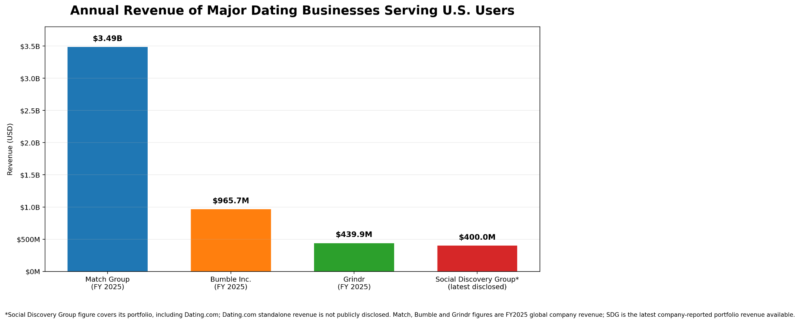
Match Group reported $3.487 billion in 2025 revenue. Bumble reported $965.7 million, while Grindr generated $439.9 million. Social Discovery Group has reported $400 million in portfolio revenue, although it is private and does not disclose audited standalone figures for Dating.com. These are global company revenues, not U.S.-only sales, because the businesses do not report domestic revenue consistently.
Lesson 1: Freemium works when free access has real value
Most dating companies use the same basic funnel. Registration is free. Browsing or matching is free. Revenue appears when users want more visibility, control or communication.
Tinder sells subscriptions and one-off boosts. Bumble charges for premium discovery tools. Grindr combines subscriptions with advertising. Dating.com uses credits for chats, selected messages and video communication.
A free product should deliver a genuine experience, not merely display locked features. Users must first understand the network’s value. Only then does paying for speed or personalization feel reasonable. The principle applies to education, fitness and creator platforms too.
The smartest freemium businesses do not make the free tier intentionally miserable. They make it useful enough for customers to develop a habit, understand the product and reach a moment when an upgrade solves a specific frustration.
In dating, that frustration might be limited profile visibility or a desire to communicate with a promising match. In business software, it could be storage, automation or collaboration. The psychology is similar even when the products are completely different.
Lesson 2: Microtransactions capture moments of intent
Subscriptions produce predictable cash flow, but dating companies have become skilled at combining them with smaller purchases.
A customer may reject a recurring $40 plan but spend several dollars to increase profile visibility before a weekend. Another user may prefer buying credits only when a conversation becomes promising. The purchase is connected to a moment of intent rather than general access.
Dating.com is interesting here. Its product overview describes search filters, standard chat, “Let’s Mingle,” and voice or video options. The platform uses pay-as-you-go credits instead of relying entirely on an unlimited membership.
For operators, this allows segmentation. Casual users can remain light spenders, while highly engaged customers can pay more. The risk is confusion, so prices, balances and renewal rules must remain easy to understand.
This hybrid approach is familiar in gaming, where a player may subscribe for basic benefits and still purchase individual items. It also appears in travel, education and productivity software. The customer pays regularly for access, then pays again when a particular action feels valuable enough.
Dating apps have become especially good at identifying those moments. The emotional stakes are higher than they are in most software categories. A user who believes one conversation could lead somewhere may be more willing to pay than someone browsing without a clear goal.
Lesson 3: The best-paying user may not be the youngest
There is no honest single portrait of the average American online dater. The audience crosses age, income and geography. The most commercially valuable subscription user is easier to identify.
Pew found that 53% of adults under 30 had tried online dating, compared with 37% of those aged 30 to 49. Younger adults enter the funnel more often, but older users are more likely to pay. Among people who had used dating platforms, 41% of users aged 30 and older had paid, compared with 22% of those under 30. Men were also more likely to pay than women, 41% versus 29%.
Income sharpens the picture. Some 45% of upper-income online daters had paid for a site or feature, compared with 36% of middle-income users and 28% of lower-income users. March 2025 data placed roughly one-third of U.S. users in high-income households and another third in low-income households, suggesting that usage itself is not confined to one economic class.
The most attractive paying persona is often a man over 30 with disposable income, a clear goal and a willingness to spend to save time. That is not the “average dater.” It is the customer most likely to convert. Younger consumers may adopt faster; older customers may pay more readily for convenience.
The broader business lesson is that the people who create traffic are not always the people who create profit.
A company may build its public image around younger users because they generate social media attention and invite friends. Its finance team may discover that an older, quieter segment produces better retention and stronger revenue per customer.
Businesses should therefore avoid treating their audience as one large average. Acquisition, engagement and payment can be driven by three very different groups.
Lesson 4: A narrow promise can outperform a broad one
Grindr’s $439.9 million in 2025 revenue is notable because it serves a focused audience. Revenue rose 27.6% from 2024, while Bumble’s total revenue fell 9.9%. A clear community proposition can monetize better than a broad product struggling to please everybody.
Hinge offers another example inside Match Group. Its direct revenue grew 26% in the fourth quarter of 2025 even as Match Group’s annual revenue remained almost flat. Specialization can mean serving a demographic, but it can also mean owning a distinct intention or stage of the customer journey.
The same logic applies elsewhere. Customers often pay when a product signals, “This was built for people like you.”
A broad platform can offer scale, but scale creates its own problems. Users may struggle to understand who the service is for, what kind of behavior is expected and whether other members want the same thing.
A focused product reduces some of that uncertainty. It may have fewer potential customers, yet each customer has a stronger reason to join.
Dating.com as an international example
Dating.com does not follow the fastest swipe model. According to the overview at dating com reviews, the brand began in 1993 and now brings together members from more than 40 countries. Profiles, filters and longer conversations give it a more international feel than a purely location-based app.
The same dating com reviews page highlights “Let’s Mingle,” chat, voice and video tools, plus credits that let members pay according to activity. This can suit people interested in cross-border communication who do not want an all-inclusive subscription immediately. The page is a partner landing page rather than an audited financial source, but it clearly explains the customer journey.
Dating.com’s standalone revenue is not public. The responsible comparison is with Social Discovery Group, its parent portfolio. SDG has reported $400 million in revenue, 62 million new users across its brands, 27 billion messages and more than 3.2 million video dates during the reported period. These are company-wide figures, not Dating.com-only metrics.
From a business perspective, the international focus is significant. A local dating app depends heavily on population density in each market. An international platform can connect users across borders, while tools such as video communication help keep them inside the ecosystem.
The credit model also connects spending directly to engagement. That can generate more revenue from active users, although it places a greater responsibility on the platform to explain costs clearly and help customers manage their spending.
Lesson 5: Trust is revenue infrastructure
Dating platforms handle identity, location and vulnerable conversations. Safety is not simply a compliance expense; it affects conversion, retention and willingness to pay.
Pew found that 52% of people who had used a dating platform believed they had encountered a scammer. It also found that paid users were more likely than non-paying users to describe their experience positively. Trust and monetization are therefore closely linked: customers pay when they believe better tools produce a better experience.
This applies to marketplaces, financial apps and online communities. A subscription business that cuts moderation or fraud prevention may improve margins temporarily while damaging lifetime value.
Trust is particularly important in businesses built around user-generated profiles. The platform does not create the core product by itself. Its members create it through their photographs, messages and behavior.
That means one fraudulent account can damage more than one conversation. It can make users question every other profile and reduce the perceived value of the entire network.
Verification, reporting tools, customer support and payment security should therefore be viewed as product investments. They protect the environment in which subscriptions and microtransactions occur.
The unusual churn problem
Dating companies face a paradox. A successful match can remove two active customers.
That creates constant pressure to replace departing users and encourages platforms to add friendship, events, video and AI-assisted communication. The product becomes a broader relationship platform rather than a single-purpose matching tool.
Better operators widen the reasons customers enter the ecosystem and create separate brands for different intentions. Match Group’s portfolio strategy and SDG’s expansion across dating, social and entertainment products reflect this logic.
The churn problem also explains why brand reputation matters so much. A person who finds a partner may cancel, but can still recommend the platform. In that situation, the lost subscriber becomes a source of low-cost customer acquisition.
A genuinely successful dating service may therefore benefit from helping people leave happy rather than finding ways to keep them endlessly searching.
What other digital businesses should copy
Dating apps show that recurring revenue is not created by putting a paywall in front of an audience. It comes from matching pricing to moments of intent.
They use free access to build network value, subscriptions to monetize regular users, microtransactions to capture bursts of demand and niche brands to reach different customer groups. Most importantly, they show that trust is part of the product.
The subscription economy of love is imperfect. Users complain about fatigue, uneven experiences and rising prices. Yet the industry continues to generate billions because the underlying need is durable.
People pay for products that make a difficult task feel easier. The broader lesson is less romantic but just as valuable: understand the customer’s moment, reduce friction and charge for meaningful progress rather than access alone.