
The Best Adventure Motorcycles for Long-Distance Touring in 2026
Adventure motorcycles designed for long-distance touring represent the most versatile machines in motorcycling, combining highway comfort with genuine off-road capability and practical features for extended journeys.
The best adventure motorcycles for long-distance touring in 2026 balance powerful engines, comfortable ergonomics, advanced electronics, generous fuel capacity, and reliable performance across thousands of miles of varied terrain.
These bikes allow you to explore remote destinations while carrying the gear you need for weeks on the road.
Choosing the right adventure bike for serious touring requires understanding how different models handle real-world demands. Modern ADV bikes have become stronger and more diverse, with manufacturers offering everything from nimble middleweights to heavyweight touring platforms.
You need to consider factors like seat comfort during all-day rides, wind protection at highway speeds, suspension quality on rough surfaces, and how much luggage capacity you require.
This guide examines the leading adventure motorcycles for 2026, comparing their touring capabilities, technology features, and ownership costs.
You will learn which models excel at specific riding styles, what innovations are reshaping the category, and how to match your touring goals with the right machine for your needs.
Ready to see who made our top picks list? Let’s go for a ride!
What Defines the Best Adventure Motorcycles for Long-Distance Touring?
The right adventure motorcycle for long-distance touring balances comfort with capability, offering features that handle extended highway miles while maintaining off-road competence. Understanding these defining characteristics helps you select a machine suited to your touring goals.
Key Features to Look For
Ergonomics and comfort stand as the foundation of any long-distance touring motorcycle. You need an upright riding position with adjustable handlebars and foot pegs that accommodate your body type.
A seat height that allows both feet to touch the ground provides confidence during stops, while seat padding must support multi-hour riding sessions without causing discomfort.
Fuel capacity directly determines your range between stops. Most capable adventure tourers carry 5 to 6.5 gallons, providing 200 to 300 miles of range depending on engine size and riding conditions.
Wind protection through adjustable windscreens reduces fatigue on highway stretches. Look for screens you can modify on the fly without tools.
Luggage capacity separates weekend riders from serious tourers. Factory hard cases or robust mounting points for aftermarket systems let you carry clothing, camping gear, and supplies. Weight capacity matters equally, check the manufacturer’s maximum load rating.
Modern adventure motorcycles combine long-distance travel capability with off-road performance through sophisticated electronics. Traction control, multiple riding modes, and ABS systems adapt to changing terrain conditions.
Differences Between Adventure and Touring Bikes
Adventure bikes prioritize versatility over specialization. They feature longer suspension travel (7 to 9 inches), knobby or dual-sport tires, and higher ground clearance than dedicated touring machines. This design philosophy means you can handle gravel roads, river crossings, or mountain passes that would stop a traditional tourer.
Touring motorcycles excel on pavement with lower seat heights, smoother suspension tuned for highways, and more comprehensive weather protection. They typically carry larger fairings, built-in audio systems, and passenger-focused amenities.
Weight distribution differs significantly between categories. Adventure bikes position their center of gravity higher for obstacle clearance, while tourers keep weight low for stability at highway speeds. A fully loaded adventure bike weighs 550 to 650 pounds, compared to 800+ pounds for full-dress tourers.
Adventure riding historically meant literal long-distance travel into remote areas rather than equal splits between pavement and dirt. This heritage influences modern designs that favor durability and simplicity over luxury features.
Benefits of Adventure Motorcycles for Touring
Route flexibility represents the primary advantage of adventure bikes for touring. You’re not confined to paved roads when detours, construction, or curiosity arise. That scenic overlook accessed by a dirt road becomes an option rather than an obstacle.
Rider visibility improves with the tall riding position. You see over traffic and spot road hazards earlier than riders on lower machines. Other drivers also notice you more easily.
Maintenance simplicity benefits from adventure bike engineering. Many models use air-cooled or simpler engine designs that prove easier to service in remote locations. Parts availability often exceeds specialized touring models, particularly in developing regions.
Resale value remains strong because adventure motorcycles serve as capable multi-terrain platforms appealing to diverse rider types. The used market stays active year-round compared to seasonal interest in pure touring bikes.
Physical engagement keeps you alert during long days. The active riding position and need to manage the bike through varying terrain reduces the highway hypnosis that affects touring riders on straight interstates.
Top Adventure Motorcycles for Long-Distance Touring in 2026
The BMW R 1300 GS leads with advanced electronics and refined comfort, while KTM’s 1290 Super Adventure S delivers aggressive performance with exceptional wind protection. Honda’s Africa Twin Adventure Sports balances reliability with off-road prowess, and the Triumph Tiger 1200 Explorer offers sophisticated touring features in a commanding package.
2026 BMW R 1300 GS
The R 1300 GS represents BMW’s flagship adventure tourer, powered by a 1,300cc boxer twin engine producing approximately 145 horsepower. You get adaptive ride height adjustment, electronic suspension that responds to road conditions in real-time, and a TFT display with full connectivity features.
The adventure motorcycle category has evolved significantly, and this BMW exemplifies that progression. Your luggage capacity exceeds 100 liters with factory panniers, while the electronically adjustable windscreen provides excellent protection at highway speeds.
Key Features:
- Adaptive cruise control with radar
- Heated grips and seats as standard
- Multiple riding modes for varied terrain
- Shaft drive for minimal maintenance
The ergonomics accommodate riders from 5’7″ to 6’3″ comfortably. Your seat height adjusts between 850mm and 890mm, making it accessible despite its size. The bike weighs approximately 549 pounds wet, which feels manageable once moving thanks to the low center of gravity.
KTM 1290 Super Adventure S
KTM’s 1290 Super Adventure S delivers 160 horsepower from its LC8 V-twin engine, making it the most powerful option in this segment. You’ll find semi-active WP suspension that adjusts compression and rebound automatically, along with cornering ABS and traction control.
The fuel tank holds 6.1 gallons, giving you a theoretical range of 250+ miles depending on riding style. Your touring comfort benefits from the 30mm taller windscreen compared to the standard model, and the quick-shifter works seamlessly in both directions.
Performance Specifications:
- Engine: 1,301cc V-twin
- Power: 160 hp @ 9,500 rpm
- Torque: 103 lb-ft @ 6,500 rpm
- Weight: 518 lbs (wet)
The electronics package includes adaptive cruise control, blind spot detection, and a 7-inch TFT screen with navigation. Your throttle response adjusts through multiple maps, from smooth touring to aggressive sport settings. The bike excels at high-speed highway cruising while remaining capable on gravel roads.
Honda Africa Twin Adventure Sports
Honda’s Africa Twin Adventure Sports prioritizes reliability and versatility with its 1,084cc parallel-twin engine producing 101 horsepower. You get a larger 6.4-gallon fuel tank compared to the standard Africa Twin, extending your range to approximately 280 miles between fill-ups.
The suspension offers 9.1 inches of travel front and rear, giving you genuine off-road capability without sacrificing on-road comfort. Your riding position remains upright and neutral, reducing fatigue during all-day rides. The DCT (Dual Clutch Transmission) option eliminates clutch work in traffic and technical terrain.
Standard Equipment:
- Showa electronically adjustable suspension
- Apple CarPlay connectivity
- LED lighting throughout
- Aluminum skid plate
The Africa Twin weighs 534 pounds with DCT, making it lighter than most competitors. Your maintenance intervals stretch to 8,000 miles for oil changes, and Honda’s reputation for durability means fewer unexpected repairs. The bike handles equally well on Interstate highways and forest service roads.
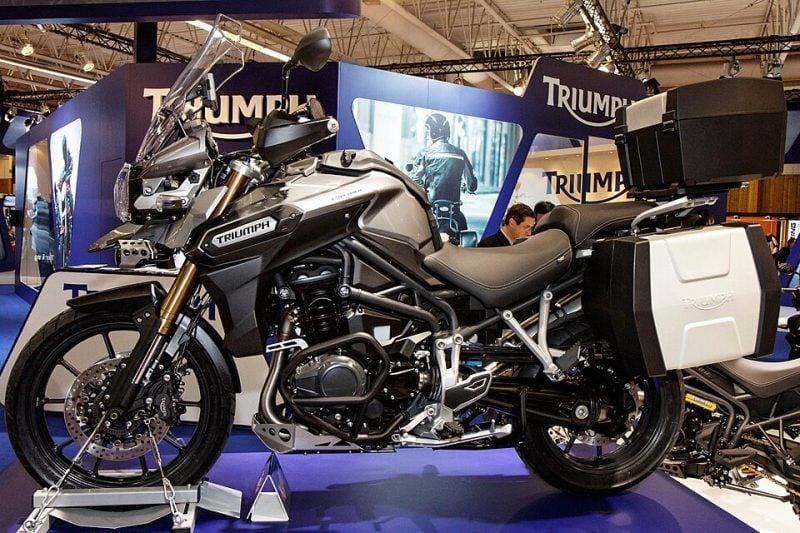
Triumph Tiger 1200 Explorer
The Tiger 1200 Explorer features a 1,160cc inline-triple engine delivering 148 horsepower with a distinctive exhaust note. You receive Triumph’s Optimized Cornering ABS and traction control that work through a six-axis IMU, providing confident braking even while leaned over.
Your comfort benefits from electronically adjustable Showa suspension, a spacious seat, and extensive wind protection from the large touring screen. The F 900 GS Adventure offers balance, but the Tiger 1200 provides more power and features for serious touring.
Technology Highlights:
- 7-inch TFT with turn-by-turn navigation
- Adaptive cornering lights
- Hill hold control
- My Triumph connectivity app
The fuel tank holds 5.3 gallons, delivering approximately 220 miles of range. Your seat height adjusts from 850mm to 870mm, and the bike tips the scales at 566 pounds ready to ride. The Explorer variant includes crash bars, fog lights, and center stand as standard equipment, making it the most tour-ready configuration Triumph offers.
Emerging Models and Innovations
The 2026 adventure motorcycle market introduces significant developments across traditional combustion engines and electric powertrains. Yamaha expands its middleweight lineup with improved displacement, Ducati refines its flagship adventure platform for extreme terrain, and Zero pushes electric adventure capabilities further than previous generations.
All-New 2026 Yamaha Ténéré 900
Yamaha addresses the gap between its popular Ténéré 700 and larger adventure bikes with the new Ténéré 900. The bike features an enlarged parallel-twin engine derived from the CP2 platform, delivering approximately 115 horsepower while maintaining the lightweight character that made the 700 successful.
The middleweight adventure bike balances long-distance touring and off-road riding, positioning itself against competitors in the growing 800-900cc segment. You get a 21-inch front wheel for off-road capability, adjustable suspension with increased travel, and a larger fuel tank for extended range.
The electronics package includes multiple riding modes, switchable ABS, and traction control that you can disable for technical off-road sections. Yamaha designed the ergonomics for standing riding positions while keeping seated comfort suitable for highway miles. The updated instrumentation features a larger TFT display with smartphone connectivity and navigation support.
Ducati Multistrada V4 Rally
The Multistrada V4 Rally represents Ducati’s most off-road-focused adventure motorcycle. It uses the same 1,158cc V4 Granturismo engine producing 170 horsepower, but adds rally-specific components for serious terrain capability.
You receive a 19-inch front wheel instead of the standard Multistrada’s 17-inch, semi-active suspension with extended travel, and reinforced engine protection. The Rally variant includes spoked wheels, knobby tire options, and a raised windscreen for standing riding positions.
Key Rally-Specific Features:
- 200mm front and rear suspension travel
- Cornering ABS with off-road mode
- 7.9-inch TFT display with turn-by-turn navigation
- 30-liter fuel capacity
- Cruise control and heated grips standard
The bike weighs 549 pounds wet, making it manageable despite its size. Ducati includes radar-assisted cruise control and blind-spot detection even on this off-road-oriented model. The V4 engine provides strong low-end torque while maintaining smooth highway cruising characteristics.
Zero DSR/X Electric Adventure Motorcycle
Zero’s DSR/X brings electric propulsion to the adventure segment with a 110-horsepower motor and 140 lb-ft of instant torque. The air-cooled powertrain eliminates overheating concerns during slow-speed technical riding while delivering acceleration that surpasses most combustion adventure bikes.
You get approximately 180 miles of city range or 85 miles at sustained highway speeds using the standard 17.3 kWh battery. The optional Charge Tank reduces charging time significantly, allowing Level 2 charging in about two hours. Zero designed the bike around a 19-inch front wheel and long-travel Showa suspension for mixed-terrain capability.
The low center of gravity from the battery placement improves handling characteristics compared to traditional adventure bikes. You control power delivery through multiple ride modes, including custom settings where you adjust regenerative braking strength and throttle response. The digital dashboard provides range estimation based on your riding style and terrain.
The DSR/X weighs 544 pounds, competitive with gas-powered middleweights. You sacrifice range for zero maintenance on chains, oil changes, and valve adjustments, making it suitable for riders with predictable route planning needs.
You know the costs. You know the specs. But what about performance? Let’s see how these ride!
Performance and Comfort on Extended Journeys
Long-distance adventure touring demands motorcycles that balance powerful performance with rider comfort across hundreds of miles. The right combination of engine capability, suspension tuning, and ergonomic design determines whether your multi-day journey becomes an unforgettable adventure or an endurance test.
Engine Power and Efficiency
You need an engine that delivers consistent power without constantly stopping for fuel. Most adventure motorcycles built for touring feature engines between 800cc and 1300cc, providing the torque necessary for loaded riding and highway passing.
Modern parallel-twin and boxer engines typically offer 5.0 to 6.5 gallons of fuel capacity with ranges exceeding 200 miles per tank. V-twin and inline-four configurations deliver smoother power delivery at highway speeds, though they may consume slightly more fuel.
Key Engine Considerations:
- Horsepower range: 90-160 hp for loaded touring
- Torque delivery: Low to mid-range torque matters more than peak numbers
- Fuel economy: 40-55 mpg depending on load and riding style
- Tank capacity: Larger tanks reduce fuel stop frequency
Suspension and Ride Quality
Your suspension absorbs everything from highway expansion joints to gravel roads over extended periods. Electronic suspension systems let you adjust damping on the fly, adapting to different loads and road conditions without tools.
Premium adventure bikes offer 7-9 inches of suspension travel with adjustable preload, compression, and rebound damping. Semi-active systems automatically adjust based on speed, acceleration, and road conditions.
You should expect fully-loaded capabilities that maintain stability with luggage and a passenger. Quality suspension prevents bottoming out on rough roads while keeping the ride compliant enough for all-day comfort.
Seat Comfort and Ergonomics
Your riding position and seat quality directly impact how many hours you can ride before fatigue sets in. Adventure touring seats typically measure 30-35 inches in height with generous padding designed for 300+ mile days.
Adjustable handlebars, footpegs, and windscreens let you customize your riding position. Wide, well-padded seats with proper contouring distribute weight across your sit bones rather than creating pressure points.
Ergonomic Features That Matter:
- Adjustable seat height (typically 1-2 inches of range)
- Heated grips and seats for cold weather touring
- Wind protection that redirects airflow away from your chest
- Natural arm and leg angles that reduce strain
Motorcycles designed for comfortable long-distance touring integrate these elements to minimize rider fatigue across varying terrain and weather conditions.
Technology and Rider Assist Features
Modern adventure motorcycles now include sophisticated electronics that enhance safety, navigation, and rider confidence across varied terrain. These systems range from real-time route guidance to intervention technologies that help prevent accidents in challenging conditions.
Integrated Navigation and Connectivity
Most 2026 adventure motorcycles feature TFT displays with built-in navigation or smartphone connectivity through Bluetooth systems. You can access turn-by-turn directions, music controls, and phone calls directly from the dash without taking your hands off the bars.
Premium models offer dedicated navigation systems with off-road mapping and track recording capabilities. These systems let you save routes, mark waypoints, and share your favorite rides with other riders through companion apps.
Connectivity packages typically include features like automatic emergency calling, theft tracking, and remote diagnostics. You can check tire pressure, fuel range, and service intervals through your smartphone before starting a long journey.
Advanced Rider Aids
Cornering ABS represents the most significant safety advancement in adventure motorcycles for real-world riding. This system adjusts braking force based on lean angle, preventing wheel lockup even when braking mid-corner on unstable surfaces.
Traction control systems now feature multiple modes tailored to different terrain types. You can select settings optimized for pavement, gravel, sand, or mud, with some bikes offering up to seven pre-configured riding modes.
Cruise control has become standard on long-distance touring models, reducing fatigue on extended highway stretches. Semi-active suspension systems automatically adjust damping based on road conditions, load weight, and riding style for optimal comfort and handling.
Lighting and Visibility Enhancements
LED headlights with adaptive beam technology adjust light patterns based on lean angle and speed. You get better illumination through corners without blinding oncoming traffic, which proves essential when riding unfamiliar mountain roads at night.
Cornering lights activate additional LED units when turning, illuminating the inside of curves where standard headlights leave dark spots. Some manufacturers include fog lights and auxiliary spotlights for improved visibility in adverse weather conditions.
Daytime running lights increase your visibility to other motorists during daylight hours. Many bikes now incorporate dynamic turn signals that sweep in the direction you’re turning, making your intentions clearer to surrounding traffic.
Luggage and Storage Solutions
Adventure motorcycles designed for long-distance touring require robust luggage systems that balance capacity, accessibility, and weather protection. The choice between factory-integrated options and aftermarket solutions depends on your specific touring needs and budget constraints.
Factory-Mounted Luggage Options
Many manufacturers now offer purpose-built luggage systems engineered specifically for their adventure platforms. BMW’s proprietary case systems feature seamless integration with their GS models, including matched paint options and dedicated mounting points that maintain the bike’s weight distribution.
Honda’s factory panniers and top cases use keyed-alike systems for convenience, while Yamaha’s hard luggage options for the Ténéré 700 prioritize durability without excessive weight. These factory luggage systems typically include crash protection and warranty coverage.
Key advantages of factory options:
- Pre-engineered mounting systems that don’t require modifications
- Matched aesthetics and color schemes
- Manufacturer warranty protection
- Optimized weight distribution and handling characteristics
Factory systems typically cost more upfront but eliminate compatibility concerns and installation challenges.
Aftermarket Luggage Systems
Aftermarket manufacturers like SW-MOTECH, Givi, and Touratech offer extensive luggage options that often exceed factory capacities. These systems provide flexibility in choosing between hard cases and soft panniers based on your riding style.
Soft luggage systems from brands like Kriega and Giant Loop reduce weight and offer collapse-when-empty convenience for mixed on-road and off-road touring. Hard cases provide superior security and weather protection for extended trips requiring hotel stays and valuable gear storage.
Popular aftermarket configurations:
- Aluminum panniers (35-45L per side) with top case (35-50L)
- Soft pannier systems with roll-top waterproofing
- Hybrid setups combining hard top cases with soft side bags
Many riders choose aftermarket systems when they need specialized features like quick-release mechanisms, expandable capacity, or compatibility across multiple motorcycles in their garage.
Fuel Range and Tank Capacity
Tank capacity directly determines how far you can ride between fuel stops, with adventure bikes offering varying ranges from 200 to over 400 miles. Your choice affects both route flexibility and daily riding comfort.
Comparing Leading Models
The Triumph Tiger 1200 leads the pack with a 7.92-gallon fuel tank, delivering approximately 300-350 miles of range depending on riding conditions. BMW’s R 1300 GS features a 5.0-gallon tank that typically provides 220-260 miles between fill-ups.
Yamaha’s Ténéré 700 offers a 4.2-gallon capacity with a range of around 180-220 miles, suitable for riders who prefer lighter weight over maximum distance. The Honda Africa Twin comes with a 6.1-gallon tank, averaging 250-290 miles per tank.
KTM’s 890 Adventure features a 5.3-gallon capacity delivering 200-240 miles of range. For extreme long-distance needs, you can add auxiliary fuel cells to most models, potentially extending range by 50-100 miles.
Impact on Trip Planning
Your fuel range determines gas station spacing requirements and influences route selection through remote areas. Bikes with 300+ mile ranges allow you to traverse most rural highways without fuel anxiety.
Planning long-distance trips requires mapping fuel stops every 150-200 miles to maintain a safety buffer. Smaller tanks demand more frequent stops but result in lighter bikes that handle better off-road.
Consider your typical riding terrain when evaluating tank size. Highway riding yields better fuel economy than technical off-road sections, where consumption can increase by 30-40%. Remote desert or mountain routes need bikes with larger tanks or aftermarket solutions.
Wind resistance, speed, and load weight all affect your actual range. Calculate conservative estimates when planning multi-day tours through areas with limited services.
Durability and Reliability for Long-Distance Travel
When you’re planning extended tours, mechanical reliability becomes non-negotiable. You need a motorcycle that tolerates demanding conditions without requiring constant maintenance stops.
Off-road reliability depends on engine durability that can handle varied maintenance schedules and riding conditions. Look for proven powertrains with established track records rather than first-year models with untested components.
Key Durability Factors:
- Engine design: Simpler engine configurations typically offer better reliability
- Maintenance intervals: Longer service intervals reduce downtime during tours
- Parts availability: Common platforms ensure you can find parts globally
- Weather resistance: Proper sealing protects electrical systems from rain and dust
Your adventure bike should include protective framework like crash bars and skid plates. These components prevent catastrophic damage during drops, which are inevitable on long journeys mixing pavement and dirt.
Consider the motorcycle’s reputation among long-distance riders. Adventure motorcycles combine long-distance travel capability with real-world terrain suitability, but not all models perform equally in challenging conditions.
Cost of Ownership and Maintenance
Adventure motorcycles designed for long-distance touring require significant upfront investment, with pricing varying substantially based on engine size and technology features. Maintenance intervals and parts availability directly impact your total ownership costs over the bike’s lifetime.
Initial Purchase Price
Entry-level adventure motorcycles typically start around $8,000 to $12,000 for models in the 650-700cc range. These bikes offer solid reliability and adequate performance for most touring needs without premium electronics packages.
Mid-range adventure tourers in the 850-950cc category generally cost between $13,000 and $16,000. You’ll find improved suspension components, better wind protection, and more advanced rider aids at this price point.
Premium adventure motorcycles exceed $18,000 and can reach $25,000 or more for fully-equipped models. These flagship machines include radar-assisted cruise control, semi-active suspension, comprehensive electronics suites, and higher-quality materials throughout. The 2026 adventure motorcycle market features multiple options across all price categories.
Long-Term Maintenance Considerations
Service intervals vary considerably between manufacturers, with some brands requiring valve checks every 6,000 miles while others extend this to 26,000 miles or more. Longer maintenance intervals reduce both shop time and ongoing costs throughout ownership.
Chain-driven models need regular chain maintenance and replacement every 15,000-25,000 miles, adding $200-400 per replacement cycle. Shaft-drive systems eliminate chain maintenance but typically cost more to repair if problems develop.
Adventure bikes suited for economical touring often feature common engine platforms shared across multiple models, improving parts availability and reducing costs. Tire replacement represents a significant recurring expense, with high-quality adventure tires costing $300-500 per set and lasting 5,000-8,000 miles depending on road versus off-road use.
Customization and Accessory Support
Adventure motorcycles excel when you can adapt them to your specific touring needs. The ability to add luggage systems, comfort upgrades, and protective gear transforms a stock bike into your ideal long-distance companion.
Most modern ADV bikes come with extensive factory accessory catalogs. You’ll find options for panniers, top cases, crash bars, skid plates, and auxiliary lighting designed specifically for your model. These manufacturer-backed accessories ensure proper fit and integration with your motorcycle’s electronics and frame.
Aftermarket support varies significantly between models. Popular platforms like the Yamaha Tenere 700 and BMW GS series benefit from countless third-party options. Less common models may limit your choices for specialized gear.
Key Accessory Categories for Touring:
- Luggage systems – Hard cases, soft bags, and tank bags
- Comfort upgrades – Seats, windscreens, and handlebar risers
- Protection – Crash bars, engine guards, and frame sliders
- Electronics – GPS mounts, USB ports, and heated grips
- Lighting – Auxiliary lights for better visibility
Dialing in your ergonomics with adjustable components makes any bike more comfortable for long rides. Simple additions like handlebar risers or footpeg relocators accommodate different rider sizes and preferences.
Consider accessory availability before purchasing. A bike with limited customization options may not adapt well to your evolving touring requirements. Strong aftermarket support gives you flexibility to modify your motorcycle as your riding style develops.
Global Availability and Dealer Networks
When selecting an adventure motorcycle for long-distance touring, you need to consider where you can purchase, service, and repair your bike both at home and abroad.
Major Manufacturer Networks
The largest adventure motorcycle brands maintain extensive dealer networks across multiple continents. BMW, Honda, Yamaha, and KTM offer the widest global coverage, with authorized dealers in most countries you’re likely to visit. This means you can find replacement parts and qualified technicians in Europe, North America, Asia, and increasingly in South America and Africa.
Suzuki and Triumph also provide solid international coverage, though their presence may be limited in remote regions. You should verify dealer locations along your planned routes before committing to a purchase.
Parts Availability Considerations
Popular models like the BMW R 1300 GS, Yamaha Ténéré 700, and Honda Africa Twin benefit from widespread parts availability. You can often find components at dealerships within 24-48 hours in urban areas.
Lesser-known manufacturers may require you to order parts internationally, which can delay repairs by weeks. This becomes critical when you’re touring in remote areas far from major cities.
Service and Warranty Support
Your manufacturer’s warranty coverage varies by region. Some brands offer international warranties that remain valid regardless of where you purchase the bike. Others limit coverage to the country of sale, which affects your long-term ownership costs and peace of mind during extended trips abroad.
Final Considerations for Choosing the Best Adventure Motorcycle
Your choice of adventure motorcycle depends on how you plan to split your time between pavement and off-road terrain. If you prioritize highway miles and comfort, look for bikes with larger windscreens, plush suspension, and ergonomic seating positions that reduce fatigue over long distances.
Weight and seat height matter significantly for real-world riding. Lighter bikes offer better maneuverability on technical trails, while heavier models provide stability at highway speeds. Consider your inseam and physical strength when evaluating different models.
The best adventure motorcycles for 2026 balance performance, off-road capability, technology, and reliability. You need to match these features to your riding style rather than choosing based on specifications alone.
Key factors to evaluate:
- Fuel tank capacity for your typical riding range
- Luggage mounting options and aftermarket support
- Seat comfort during multi-hour riding sessions
- Electronic rider aids like traction control and ABS modes
- Service intervals and maintenance costs
- Parts availability in remote areas
Your budget should account for protective gear, luggage systems, and essential modifications. Adventure touring motorcycles come equipped with features like large fuel tanks and strong frames, but you may need to upgrade tires based on your terrain preferences.
Test ride multiple bikes before committing to a purchase. What works for one rider may not suit your body type, skill level, or touring ambitions. Pay attention to how each bike feels during low-speed maneuvering and sustained highway cruising.


