BMW X3 vs Audi Q5: Which Luxury SUV Is Better for Daily Driving?
The BMW X3 and Audi Q5 are among the most popular options in the compact luxury SUV segment, and both received complete redesigns recently. You need a vehicle that handles your commute, weekend errands, and family duties without compromise.
For daily driving, the BMW X3 offers more engaging handling and a sportier feel, while the Audi Q5 provides a quieter cabin and more refined ride quality, making your choice dependent on whether you prioritize driving dynamics or comfort.
Both vehicles deliver premium materials, advanced technology, and strong safety features that justify their luxury pricing.
The differences between them become clear when you examine how they perform in real-world driving conditions. Your decision will depend on what matters most during your daily routine, from navigating city traffic to highway cruising.
This comparison examines every aspect that affects your daily driving experience, from initial impressions to long-term ownership costs.
You’ll learn how these two luxury SUVs compare in design, performance, and features to help you make an informed decision. We’ll break down the practical differences that matter when you’re behind the wheel every day.
First Impressions and Curb Appeal
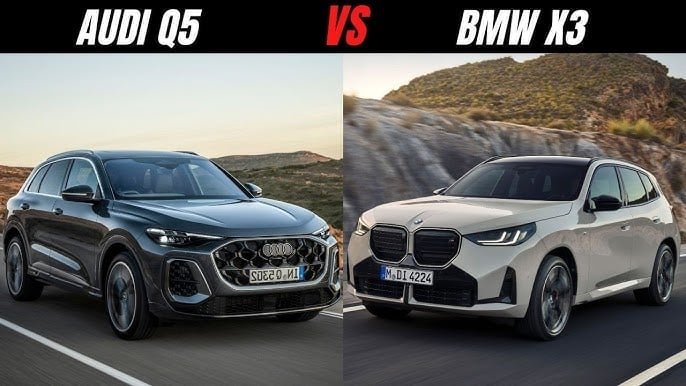
The BMW X3 adopted a radically different design with its latest redesign, while the Audi Q5 maintains a more evolutionary approach to its styling. Both vehicles command attention on the street, though they achieve this through distinctly different design philosophies that reflect their respective brand identities.
Modern Styling and Exterior Details
The BMW X3 features a bold front fascia with larger kidney grilles that dominate the front end. The grille design represents a departure from previous generations, creating a more aggressive stance that you’ll either love or find too dramatic for your taste. LED headlights come standard, and the body lines are sharper and more angular than before.
The Audi Q5 takes a more refined approach with its signature Singleframe grille and sophisticated LED lighting elements. The exterior design emphasizes clean lines and smooth surfaces that create an understated elegance. You’ll notice the Q5’s proportions appear slightly more balanced, with a lower roofline that gives it a sportier profile without sacrificing interior space.
Both SUVs offer wheel sizes ranging from 18 to 21 inches depending on trim level. The X3’s wheel arches are more pronounced, while the Q5’s flush better with the body panels for a cleaner look.
Brand Prestige and Market Appeal
Both the Audi Q5 and BMW X3 are among the most popular options for shoppers seeking a small luxury SUV. The BMW badge carries strong associations with driving dynamics and sportiness, which appeals to buyers who prioritize performance credentials.
Audi’s reputation centers on refined interiors and advanced technology. The Q5 represents a global hit for Audi, with strong sales across multiple markets. Your choice between these badges often depends on which brand values align with your personal preferences.
The X3 tends to attract buyers who want their vehicle to make a bolder statement. The Q5 appeals to those who prefer sophistication over showiness.
Interior Comfort and Daily Convenience
Both SUVs deliver premium materials and thoughtful layouts, though the BMW X3 adopted a radically different design in its latest redesign while the Q5 maintains a more traditional approach to luxury cabin design.
Cabin Space and Seating Quality
The Audi Q5 offers 41.7 inches of front legroom and 37.8 inches in the second row. The BMW X3 provides slightly more rear legroom at 39.1 inches, which makes a noticeable difference for taller passengers on longer drives.
Both vehicles feature standard leather upholstery in their base trims. The Q5’s seats provide firmer bolstering that holds you in place during cornering, while the X3 opts for a softer, more relaxed seating position. You’ll find eight-way power adjustment standard on both SUVs.
The Q5’s cabin height measures 39.1 inches up front, giving you a more commanding driving position. Rear passengers get 38.1 inches of headroom. The X3 matches these dimensions closely, though its redesigned roofline can feel slightly more enclosed.
Technology Integration and User Experience
The 2025 X3 comes with BMW’s latest iDrive 9 system on a curved display that combines a 12.3-inch digital gauge cluster with a 14.9-inch touchscreen. The Q5 uses Audi’s MMI system with dual screens: a 12.3-inch digital cockpit and a 10.1-inch center display.
Your daily interaction with the X3’s system relies heavily on touch inputs and voice commands, as BMW has reduced physical buttons. The Q5 retains more traditional controls, including a volume knob and climate control buttons that you can operate without looking away from the road.
Smartphone Integration:
- Apple CarPlay: Wireless on both
- Android Auto: Wireless on both
- Native apps: Both support streaming services
The Q5’s voice recognition system requires more precise commands, while BMW’s natural language processing understands casual phrasing better.
Cargo Capacity and Versatility
The BMW X3 provides 30.9 cubic feet behind the second row and 62.7 cubic feet with seats folded. The Audi Q5 offers less space at 25.8 cubic feet and 53.1 cubic feet respectively.
Your weekly grocery runs or weekend gear fits more comfortably in the X3. The difference of five cubic feet behind the seats equals roughly three additional carry-on suitcases. Both SUVs feature 40/20/40 split-folding rear seats that let you carry longer items like skis while still seating two passengers.
The Q5’s cargo floor sits slightly higher, requiring more effort to load heavy items. The X3 includes underfloor storage compartments that keep smaller items organized. Both offer hands-free power liftgates as standard equipment on most trims.
Performance and Driving Dynamics
The BMW X3 delivers more spirited acceleration and sharper handling, while the Audi Q5 prioritizes a smoother, more refined ride quality. Your choice depends on whether you value driving engagement or daily comfort.
Engine Options and Acceleration
The 2025 BMW X3 comes standard with a 2.0-liter turbocharged four-cylinder engine producing 248 horsepower and 258 lb-ft of torque. This setup accelerates the X3 from 0-60 mph in approximately 6.0 seconds, giving you confident merging power on highways.
The 2025 Audi Q5 also features a 2.0-liter turbocharged four-cylinder engine, generating 261 horsepower and 273 lb-ft of torque. You’ll reach 60 mph in about 5.9 seconds, making it marginally quicker than the base X3.
Both SUVs offer more powerful variants. The X3 M40i boosts output to 382 horsepower, while the Q5’s optional engine reaches similar performance levels. You’ll find both luxury SUVs chase the same buyers with comparable power delivery and acceleration times.
Handling in City and Urban Settings
The BMW X3 exhibits sharper steering response and more direct feedback through corners. You’ll notice the X3’s sport-tuned suspension keeps body roll minimal when navigating tight city streets or taking highway on-ramps aggressively.
The Audi Q5 takes a different approach with lighter steering effort and a more relaxed chassis setup. This makes parallel parking and low-speed maneuvering less taxing during your daily commute. The Q5’s Quattro all-wheel-drive system provides confident traction in various conditions without the sporty edge.
Your parking experience differs between these models too. Both vehicles have similar exterior dimensions, but the Q5’s steering calibration makes tight urban spaces slightly easier to navigate.
Ride Comfort and Noise Insulation
The Audi Q5 delivers superior ride comfort over broken pavement and road imperfections. You’ll experience less harshness transmitted through the cabin when driving over potholes or expansion joints during your commute.
The BMW X3’s firmer suspension setup creates a more connected feel to the road but sacrifices some compliance. You might find this trade-off acceptable if you prioritize handling precision over cushioned comfort.
Noise insulation favors the Q5, which features more sound-deadening materials throughout the cabin. Wind and road noise remain better suppressed at highway speeds in the Audi. The X3 allows slightly more tire noise to enter the cabin, particularly on coarse pavement surfaces.
Fuel Efficiency and Running Costs
The BMW X3 delivers superior fuel economy while the Audi Q5 offers competitive efficiency with slightly higher ownership costs. Both vehicles require premium fuel and follow similar maintenance intervals, though specific service costs vary between the two German brands.
Real-World MPG Comparisons
The BMW X3 achieves better fuel economy at 29 combined mpg for the xDrive30 model compared to the Q5’s 25 combined mpg. You’ll find the X3 returns 27 mpg city and 33 mpg highway in real-world conditions, while the Q5 delivers 23 mpg city and 29 mpg highway.
For your daily commute, the X3’s efficiency advantage translates to fewer fuel stops. If you drive 15,000 miles annually, you’ll save approximately 80 gallons of premium fuel per year with the X3.
The Q5’s base engine produces 268 horsepower compared to the X3’s 255 horsepower, which partially explains the efficiency difference. Both vehicles use turbocharged four-cylinder engines, but the X3’s powertrain prioritizes economy without sacrificing performance.
Maintenance Schedules and Expenses
Both vehicles follow similar maintenance schedules with oil changes recommended every 10,000 miles. The X3 includes complimentary scheduled maintenance for three years or 36,000 miles, while Audi typically doesn’t offer this benefit.
Your routine maintenance costs will be comparable between both models after the complimentary period ends. Expect to pay $150-$200 for oil changes and $300-$400 for major services at dealer facilities.
The X3’s lower starting price of $51,125 compared to the Q5’s $52,200 gives you additional budget flexibility. Premium fuel requirements are identical for both vehicles, so you won’t see differences in fuel costs beyond consumption rates.
Safety Features and Driver Assistance
Both the BMW X3 and Audi Q5 bring strong safety credentials with comprehensive protection systems and modern driver aids. The Q5 includes adaptive cruise control as standard equipment, while the X3 makes this feature optional but offers unique traffic jam assistance.
Active and Passive Safety Systems
Your BMW X3 comes equipped with a robust airbag system, reinforced body structure, and stability control that work together during collisions. The vehicle includes front, side, and curtain airbags along with active headrests designed to reduce whiplash injuries.
The Audi Q5 features Audi pre sense®, lane departure warning, traffic sign recognition, rear parking aid, and Active Front Assist. Active Front Assist combines emergency braking, turn assist, and evasive maneuver support into one system. Both vehicles earned top safety ratings in crash testing.
The X3 provides similar structural protection with high-strength steel construction and crumple zones. You get standard parking sensors and a backup camera to help avoid low-speed accidents in parking situations.
Advanced Driver Aids in Daily Traffic
Both manufacturers offer similar standard driver assistance features including forward collision warning, automatic braking, lane keeping assistance, and blind-spot warning. The Q5 gives you adaptive cruise control without requiring extra payment.
The X3 distinguishes itself with hands-free highway driving assistance designed for traffic congestion that operates at speeds up to 40 mph. This system takes over steering during stop-and-go traffic on highways, reducing driver fatigue during your commute.
Your Q5’s traffic sign recognition actively monitors speed limits and displays them in the instrument cluster. Both vehicles offer automated parking systems that can steer into parallel or perpendicular spaces while you control the accelerator and brake.
In-Car Technology and Infotainment
Both the BMW X3 and Audi Q5 deliver advanced digital ecosystems with multiple screen configurations and comprehensive connectivity options, though they differ in their interface philosophies and feature implementation.
Connectivity and Smartphone Integration
The BMW X3 comes standard with wireless Apple CarPlay and Android Auto across all trim levels. You’ll find the iDrive 9 system running on a curved display that combines a 12.3-inch digital instrument cluster with a 14.9-inch touchscreen.
The Audi Q5 also offers wireless Apple CarPlay and Android Auto as standard equipment. Your Q5’s technology focus includes an 11.9-inch touchscreen with Audi’s MMI interface and a 12.3-inch digital cockpit display.
Both vehicles support multiple USB-C ports and wireless charging. The X3 provides up to five USB-C ports depending on the configuration, while the Q5 offers four ports throughout the cabin. You’ll get built-in Wi-Fi hotspot capability in both SUVs, supporting multiple device connections simultaneously.
Navigation Systems and Digital Interfaces
The BMW X3’s iDrive 9 system features cloud-based navigation with real-time traffic updates and over-the-air update capability. You control it through touch, voice commands using the BMW Intelligent Personal Assistant, or the console-mounted dial controller.
The Audi Q5 uses the MMI touch response system with natural language voice control and Google Earth integration for its navigation. Your commands can be spoken naturally, and the system responds to “Hey Audi” voice activation.
Both systems display navigation directions in your digital gauge cluster. The X3’s head-up display is available as an option and projects turn-by-turn directions onto the windshield, while the Q5 also offers this feature in higher trims. You’ll find that both interfaces support customizable home screens and user profiles that remember your preferences.
Ownership Experience and Reliability
Both SUVs offer four-year/50,000-mile warranties, though the BMW X3 generally scores higher in reliability ratings while the Audi Q5 has reported more frequent issues despite its premium build quality.
Warranty Coverage and Support
BMW and Audi both provide identical basic warranty coverage: four years or 50,000 miles of bumper-to-bumper protection. Your powertrain receives the same coverage period under both brands.
BMW includes four years of complimentary scheduled maintenance, which covers oil changes, brake fluid, and other routine services at no cost. Audi discontinued its complimentary maintenance program, so you’ll pay out of pocket for oil changes and scheduled services from day one.
Both manufacturers offer roadside assistance for four years. You can extend coverage through manufacturer-backed programs, though these extended warranties typically cost $2,000 to $4,000 depending on coverage length and deductible options.
Long-Term Durability Reports
The X3 consistently receives higher marks for reliability and owner satisfaction in industry surveys. You’ll find fewer reported problems with electrical systems and drivetrain components in the BMW.
The Q5 tends to experience more issues with its infotainment system, electrical components, and turbocharger longevity after 60,000 miles. Repair costs for Audi components often run 10-15% higher than equivalent BMW parts.
Both vehicles depreciate at similar rates, losing approximately 45-50% of their value after five years. Your maintenance costs for either vehicle will average $1,200 to $1,500 annually once the warranty expires.
Resale Value and Depreciation Trends
When you’re investing in a luxury SUV, understanding how well your vehicle will hold its value matters for your long-term finances.
The BMW X3 demonstrates strong residual values, retaining around 57-60% of its original MSRP after 3 years. This positions it as a solid choice if you plan to sell or trade in your vehicle down the road.
The Audi Q5 maintains a resale value retention of about 58% after three years, which puts it nearly on par with the X3. Both vehicles perform well in this category compared to other luxury SUVs.
Key Depreciation Factors:
- Brand reputation – Both BMW and Audi carry strong luxury credentials
- Model popularity – High demand keeps values stable
- Maintenance costs – Similar ownership expenses affect long-term value
- Market conditions – Luxury SUV segment remains competitive
You’ll find that both models hold their value better than many competitors in the luxury compact SUV segment. The difference between them is minimal, typically within a few percentage points depending on trim level and market conditions.
Your specific depreciation will vary based on factors like mileage, condition, and optional features. Higher-end trims with desirable packages tend to retain value better than base models. Neither vehicle presents a clear advantage in this category, so you can feel confident choosing either based on other priorities.
Final Thoughts and Recommendations
The Audi Q5 and BMW X3 are among the most popular options for small luxury SUV shoppers, and both excel at daily driving duties. Your choice depends on what matters most in your routine.
Choose the BMW X3 if you prioritize:
- Better fuel economy for your daily commute
- A more engaging, sporty driving experience
- Lower entry price while maintaining premium quality
- Advanced driver assistance features
Choose the Audi Q5 if you value:
- More powerful base engine performance
- Refined interior materials and build quality
- Available air suspension for superior ride comfort
- Latest MMI infotainment technology
The BMW X3 delivers 27/33 mpg versus the Q5’s 23/29 mpg, making it more economical for frequent driving. However, the Q5 counters with 268 horsepower compared to the X3’s 255 horsepower from their base engines.
For urban commuting where fuel efficiency matters, the X3 edges ahead. If your daily drive includes highway cruising where comfort takes priority, the Q5’s available air suspension provides a smoother ride.
Both vehicles received full redesigns last year, so you’re getting modern technology and safety features regardless of your selection. Test drive both models to determine which cabin layout, driving dynamics, and feature set align better with your daily needs. Neither choice will disappoint for regular use.