
Are Overseas Business Expenses Costing More Than They Should?

Software subscriptions, supplier payments, and business travel create regular international spending for many Singapore businesses. These overseas business expenses can involve foreign exchange (FX) charges, alongside potential cashback on qualifying purchases.
Small differences in transaction charges and rewards can become significant over a year. A company spending S$5,000 monthly on overseas debit card purchases makes S$60,000 in annual payments before FX fees and cashback are considered. Comparing annual net outcomes helps businesses evaluate the cost of different payment arrangements.
Checking FX charges, eligible merchant categories, and cashback conditions can help businesses manage these expenses. DBS offers a Business Multi-Currency Account and Business Advance+ Debit Card combination that can be assessed alongside other banking options.
Why Overseas Business Expenses Can Cost More Than Expected
An overseas invoice shows the agreed purchase price, while the amount debited can depend on the billing currency and conversion method. Singapore’s national financial education program states, “The foreign exchange rates used may vary from day to day and from bank to bank.” Checking the posted debit against the invoice can reveal how the final amount was calculated.
Foreign Currency Transaction Charges
Card providers may apply administrative charges to payments made in foreign currencies. When reviewing foreign currency transaction fees, consider the stated charge separately from the exchange rate applied. Overseas merchants offering Singapore-dollar checkout can also use their own conversion rates, which may affect the overall amount paid.
Missed Cashback Opportunities
Cashback depends on qualifying transaction types rather than the purchase amount alone. Merchant category codes, monthly thresholds, and program conditions determine whether spending on software, advertising, travel, or professional services generates a rebate. Businesses can therefore assess how much of their purchasing activity is eligible before treating cashback as a recurring saving.
These checks reveal how payment arrangements can affect the cost of essential purchases.
How to Calculate the True Cost of Overseas Business Spending
Build a transaction register using recent invoices and card statements, with separate entries for foreign-currency card purchases, local-currency charges from overseas merchants, and bank transfers. This distinction matters because each payment method may have its own conversion process and fees. Record the original currency, supplier invoice amount, and final debit in Singapore dollars.
Review Recurring Overseas Transactions
As MoneySense explains, “When you shop with your debit card or ATM card, the transaction amount is immediately deducted from your bank account.” Reconcile each debit with the corresponding invoice to identify recurring SaaS tools, irregular supplier orders, and employee travel costs. Group transactions by expense category so different cashback rules can be applied accurately.
Account for Fees and Potential Rewards
For an annual review, use these checks:
- Transaction charges: Identify the percentage or fixed fee applied to each relevant payment.
- Currency conversion: Compare the exchange rate used with the rate quoted at checkout.
- Eligible rewards: Apply cashback only to purchases meeting merchant category and minimum-spend conditions.
Add the annual charges and subtract qualifying rewards to calculate the net card outcome. Evaluate insurance benefits separately using their coverage limits and eligibility criteria, assigning a cash value only where it can be justified. This method supports a consistent comparison across payment arrangements.
What Can Businesses Do to Reduce Overseas Payment Costs?
Choose payment methods based on how suppliers bill and how often transactions occur. Assess overall costs and convenience for card purchases and supplier transfers.
Review Payment Methods and Foreign Currency Charges
A multi-currency account can help businesses hold supported currencies for supplier payments. For overseas business payments, compare exchange rates, transaction fees, account charges, and processing times. S$0 card FX fees eliminate one charge, while conversion rates still affect the final amount paid.
Match Cashback Benefits to Business Spending
Cashback depends on merchant categories and spending thresholds. The DBS Business Multi-Currency Account and Business Advance+ Debit Card combination offers S$0 FX fees on foreign-currency card purchases and unlimited 1% cashback on qualifying business-to-business (B2B) spending, subject to S$2,000 in monthly card spend. Cashback is credited quarterly.
These features can be compared with other banks using a consistent spending scenario.
Comparing Bank Transactions for S$60,000 in Annual Foreign Purchases
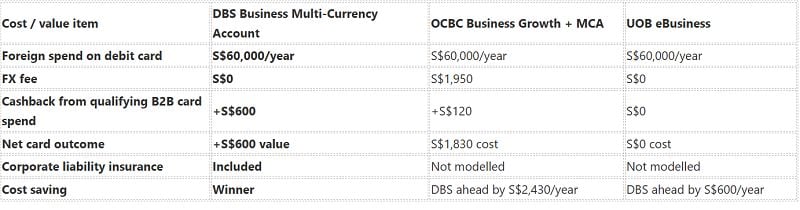
In this illustration, a business makes S$5,000 in overseas debit card payments monthly, or S$60,000 annually. The comparison examines FX fees, qualifying cashback, and corporate liability insurance across DBS, OCBC, and UOB.
Overseas SaaS, travel, and supplier expenses
What the Comparison Reveals
In the baseline, DBS incurs S$0 modeled FX fees and receives +S$600 cashback, giving +S$600 value. OCBC shows S$1,950 in assumed charges offset by +S$120 cashback, resulting in S$1,830 cost. UOB is assigned S$0 FX fees and S$0 cashback on overseas spend, producing a S$0 cost outcome.
The model places DBS ahead of OCBC by S$2,430/year and UOB by S$600/year. The insurance row records DBS as Included and leaves competitor benefits unvalued, although UOB separately advertises a corporate liability waiver.
What Could Affect the Actual Savings?
OCBC’s S$1,950 FX cost assumes an illustrative 3.25% rate, while its cashback uses the 0.2% base rate. Selected software and travel transactions may earn 1% cashback. If all OCBC purchases qualified at that rate, DBS’s modelled lead would narrow to S$1,950.
DBS’s S$600 cashback assumes purchases fall within eligible B2B categories and meet the S$2,000 monthly threshold. Travel-heavy spending could earn less because travel falls outside the listed cashback categories. Actual results depend on spending patterns and payment terms.
Which Banking Option Offers Better Value for Overseas Business Spending?
DBS offers the strongest modelled outcome for businesses whose overseas card purchases largely qualify for B2B cashback. Businesses with substantial travel costs or frequent supplier transfers should separately assess cashback eligibility and transfer charges.
Use recent statements to estimate qualifying purchases and the fees attached to each payment method. Compare those results with supported currencies, account charges, exchange rates, and insurance cover. This will show whether the illustrated DBS advantage applies to the business’s actual spending.
Frequently Asked Questions
What expenses count as overseas business spending?
Common examples include payments to overseas suppliers, foreign software providers, professional services firms, and travel merchants. The charges depend on the transaction currency and processing arrangement.
Can businesses earn cashback on overseas software subscriptions?
Yes. A software subscription can qualify when its merchant category code meets the card’s reward conditions. The code, rather than the invoice description, determines eligibility.
Does cashback apply to overseas business travel?
Yes, with selected card programs. OCBC includes eligible airline, hotel, and tour-operator purchases among its 1% cashback categories, while DBS applies its 1% offer to selected B2B categories.
Are foreign transaction fees different from currency conversion rates?
Yes. The fee is a separate charge, while the conversion rate determines the amount exchanged. Currency conversion costs can still arise with S$0 card FX fees.
How can a multi-currency account support overseas business payments?
It can hold incoming funds and pay suppliers in supported foreign currencies. Using an existing balance may reduce repeated currency conversions, subject to applicable transfer fees.
Reduce Extra Costs on International Business Payments
Reviewing overseas business expenses by transaction type and payment currency can help identify practical opportunities to reduce annual charges. Comparing actual fees and eligible rewards provides a clearer basis for choosing a suitable payment arrangement for future purchases.
Explore the DBS Business Multi-Currency Account and Business Advance+ Debit Card to see how supported currencies, S$0 card FX fees, and qualifying cashback can support your company’s overseas payments.


