Toyota Land Cruiser vs Lexus GX 460: A Comprehensive Long-Term Ownership Analysis
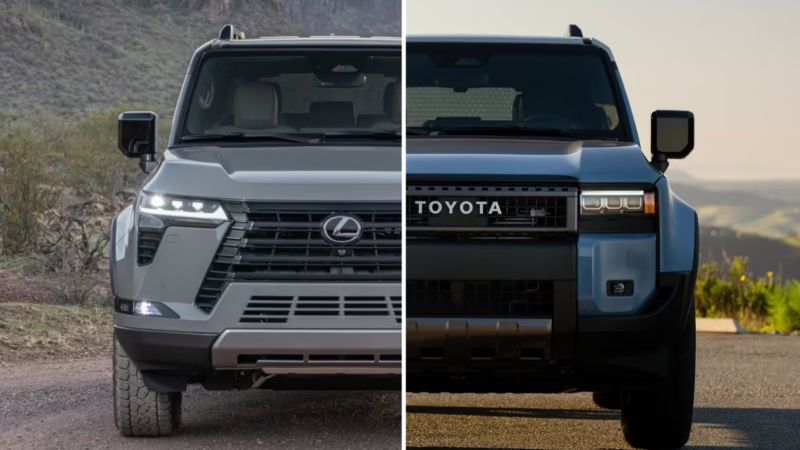
The Toyota Land Cruiser and Lexus GX represent two of the most capable luxury SUVs available, sharing fundamental engineering while targeting different buyers.
Both vehicles trace their roots to Toyota’s legendary off-road heritage and offer exceptional durability. Understanding which SUV better suits your long-term ownership needs requires examining factors beyond initial purchase price.
For most buyers focused on long-term ownership, the choice between these SUVs comes down to whether you prioritize the Land Cruiser’s rugged simplicity and lower purchase price or the GX’s additional luxury features and refined interior appointments.
The GX and Land Cruiser share bones and the same off-road ready ethos, making this a comparison between closely related vehicles rather than fundamentally different platforms.
Your decision should account for reliability expectations, maintenance expenses, fuel economy, resale values, and how each vehicle’s features align with your daily driving requirements. This comparison examines the practical aspects of ownership that matter most over a five to ten year period.
Model Overview and Heritage
Both SUVs trace their roots to Toyota’s legendary off-road engineering, though they’ve evolved to serve different market segments while maintaining their rugged capabilities.
Brand History and Reputation
The Toyota Land Cruiser debuted in 1951 as a utilitarian off-road vehicle inspired by military Jeeps. Over seven decades, it built a reputation for extreme durability and reliability in the harshest environments worldwide. The nameplate became synonymous with indestructible engineering, often lasting 300,000 miles or more.
Toyota discontinued the full-size Land Cruiser in the U.S. market after 2021, then revived it as a mid-size model for 2024. The new version maintains the heritage of go-anywhere capability but targets adventure-focused buyers rather than luxury shoppers.
Lexus introduced the GX 460 in 2010 as a luxury-focused counterpart to Toyota’s body-on-frame SUVs. The model carries Toyota’s mechanical reliability while adding premium materials, advanced technology, and refined comfort that appeal to upscale buyers.
Model Lineage and Evolution
The current Land Cruiser represents a strategic shift for Toyota. Unlike its predecessor, which grew increasingly expensive and luxurious, the new model emphasizes affordability and practicality. It measures smaller than previous generations but gains modern hybrid efficiency.
The Lexus GX shares its platform with the Land Cruiser, creating a close mechanical relationship between the two. Both ride on Toyota’s TNGA-F body-on-frame architecture designed for serious off-road work. Despite this shared foundation, they feature distinct powertrains and interior appointments.
The GX evolved from the earlier GX 470 and maintains a third-row seating option that appeals to families. Its design philosophy prioritizes refinement alongside capability.
Target Audience and Purpose
You’ll find the Land Cruiser appeals to outdoor enthusiasts and families seeking adventure without luxury pricing. Its hybrid powertrain delivers efficiency for daily commutes while maintaining weekend trail credentials. The starting price positions it as an accessible option for buyers who prioritize capability over premium features.
The GX targets luxury buyers who refuse to compromise on off-road ability. You get more powerful engine options, upscale cabin materials, and advanced technology systems. The higher price reflects its positioning as a premium vehicle that happens to excel off-road, rather than an off-roader dressed up with luxury touches.
Long-Term Reliability Analysis
Both vehicles share Toyota’s proven engineering foundations, with the GX 460 benefiting from the same core components that have made the Land Cruiser a reliability benchmark. Your choice between these SUVs largely depends on whether you prioritize the Land Cruiser’s simpler mechanical layout or the GX 460’s added luxury features.
Engine Dependability
The Land Cruiser’s engine lineup varies by generation, but modern versions typically feature Toyota’s robust V6 or V8 powerplants known for exceeding 300,000 miles with proper maintenance. The GX 460 uses a 4.6-liter V8 that produces 301 horsepower and has demonstrated exceptional longevity across its production run.
You’ll find that both engines share similar maintenance intervals and parts commonality. The GX 460’s V8 requires attention to timing chain tensioners around 100,000 miles, though this remains a relatively minor concern. Oil consumption can increase in higher-mileage examples of both vehicles, particularly if you skip oil changes or use incorrect viscosity.
Your maintenance costs remain reasonable due to widespread parts availability. The GX 460 benefits from Toyota roots, making repairs affordable even as mileage climbs. Both engines tolerate regular unleaded fuel, though premium is recommended for the GX 460 to maximize performance.
Transmission and Drivetrain Durability
The GX 460 uses a six-speed automatic transmission paired with full-time four-wheel drive, while the Land Cruiser typically features similar transmission technology depending on the model year. Both drivetrains handle demanding off-road conditions and towing without significant issues.
Your transmission fluid changes should occur every 60,000 miles to maintain optimal performance. The transfer cases in both vehicles rarely require attention beyond fluid changes at similar intervals. You won’t encounter the transmission failures common in other luxury SUVs when you follow recommended service schedules.
The full-time four-wheel-drive systems distribute power effectively and contribute to the long-term durability of both platforms. Your differential maintenance involves straightforward fluid changes that prevent premature wear.
Common Mechanical Issues
You should monitor suspension components including bushings, control arms, and ball joints after 80,000 miles in both vehicles. The GX 460’s adaptive suspension adds complexity but doesn’t significantly impact reliability when properly maintained.
Common wear items include:
- Brake pads and rotors (every 40,000-60,000 miles)
- Timing chain components (inspect at 100,000 miles)
- Water pumps (typically 100,000+ miles)
- Alternators and starters (150,000+ miles)
Your secondary air injection system in the GX 460 may require attention as vehicles age, with valves occasionally failing and triggering check engine lights. The Land Cruiser faces similar emissions-related component wear. Both vehicles experience minimal electrical issues compared to European competitors, with most problems limited to minor sensor failures that are inexpensive to address.
Ownership Costs Over Time
Both SUVs share mechanical DNA and Toyota’s reputation for reliability, but their ownership costs diverge significantly due to different market positioning and depreciation patterns.
Maintenance and Repair Expenses
The Toyota Land Cruiser and Lexus GX share the same platform and mechanical components, which means maintenance schedules and repair costs remain similar for drivetrain work. Both vehicles use proven V6 turbocharged engines in their 2026 models that require regular oil changes, brake service, and tire rotations at comparable intervals.
Your maintenance costs will be slightly higher with the GX due to Lexus dealership labor rates, which typically run 10-15% more than Toyota service centers. However, the GX includes complimentary maintenance for the first two years or 25,000 miles, offsetting some of this premium. Parts pricing differs minimally for shared components like brakes, filters, and suspension elements.
Where costs diverge is in luxury-specific repairs. The GX features more complex electronic systems, premium audio equipment, and additional comfort features that can require specialized attention. Your Land Cruiser’s simpler interior and fewer electronic modules generally translate to lower repair bills when issues arise outside the powertrain.
Insurance Premiums
Your insurance premiums will run higher for the Lexus GX due to its elevated starting price and luxury brand classification. Insurance companies base rates partly on vehicle replacement costs, and the GX starts several thousand dollars above the Land Cruiser.
The luxury badge matters to insurers beyond just purchase price. Lexus-branded parts cost more to replace, and repair facilities charge premium labor rates for luxury vehicles. You can expect to pay 8-12% more annually for comprehensive and collision coverage on the GX compared to the Land Cruiser with similar coverage levels.
Depreciation Trends
The depreciation comparison between these models shows the Land Cruiser historically holds value better than the GX. Toyota’s SUV maintains stronger resale values due to its cult following and reputation for extreme durability in global markets.
Your GX will depreciate faster in the first three years, losing approximately 35-40% of its value. The Land Cruiser typically depreciates 30-35% over the same period. This difference matters significantly when you consider the GX’s higher starting price—you lose more actual dollars even if the percentage seems comparable.
The Land Cruiser benefits from lower production volumes and stronger overseas demand, which supports used values domestically.
Performance and Driving Experience
Both SUVs deliver capable performance with different philosophies: the Land Cruiser prioritizes refined power and efficiency through its modern turbocharged hybrid system, while the GX 460 relies on a naturally aspirated V8 for straightforward, proven capability.
On-Road Comfort and Handling
The Land Cruiser provides a more modern on-road experience with its updated suspension tuning and lighter curb weight. You’ll notice smoother transitions over highway undulations and more composed handling in daily driving scenarios. The hybrid powertrain delivers instant torque from the electric motor, making city driving and highway merging effortless.
The GX 460 feels more traditional in its approach to comfort. Its body-on-frame construction transmits more road imperfections into the cabin compared to modern unibody competitors, though it remains comfortable for long highway trips. You’ll experience more body roll in corners due to the higher center of gravity and softer suspension tuning designed primarily for off-road compliance. The steering is light and easy to manage but provides less feedback than the Land Cruiser’s more weighted setup.
Off-Road Capability
Both vehicles share similar off-road foundations with body-on-frame construction and available locking differentials. The Land Cruiser offers crawl control, multi-terrain select, and a sophisticated electronic traction management system that simplifies technical terrain. Ground clearance sits around 8.9 inches depending on configuration.
The GX 460 provides comparable capability with its Kinetic Dynamic Suspension System (KDSS) on certain trims, which automatically adjusts sway bars for better articulation. You get similar approach and departure angles, making both vehicles competent on serious trails. The GX’s V8 torque curve provides predictable power delivery when crawling over obstacles.
Engine Performance and Towing
The Land Cruiser uses a 2.4-liter twin-turbocharged four-cylinder hybrid producing 326 horsepower and 465 lb-ft of torque. This powertrain delivers superior torque for towing with maximum capacity around 8,000 pounds. Fuel efficiency improves significantly over the GX, achieving approximately 22-23 mpg combined.
The GX 460 employs a 4.6-liter V8 generating 301 horsepower and 329 lb-ft of torque. Towing capacity reaches 6,500 pounds, adequate for most recreational trailers but notably less than the Land Cruiser. You’ll see fuel economy around 16-17 mpg combined, which means higher operating costs over time.
Interior Features and Comfort
The Land Cruiser and GX prioritize comfort and opulence differently, with the Lexus offering more premium materials and the Toyota focusing on durability with refined touches. Your choice depends on whether you value luxury-focused features or practical comfort built for adventure.
Seating Quality and Space
The Lexus GX provides semi-aniline leather seating in higher trims with more cushioning and support than the Land Cruiser’s standard offerings. You’ll find heated and ventilated front seats available on both models, though the GX adds massage functions on premium trims.
The Land Cruiser’s top trim comes close to a basic GX in terms of comfort materials. Both SUVs offer three-row seating configurations, but legroom differs notably in the third row. The GX provides slightly more shoulder room in the second row, while the Land Cruiser’s seats feel more upright and supportive for longer journeys.
You’ll notice the GX features softer-touch materials throughout the cabin, including genuine wood trim options. The Land Cruiser uses more durable synthetic materials that resist wear better but feel less luxurious to the touch.
Technology and Infotainment
The GX comes standard with a 14-inch touchscreen running Lexus Interface, while the Land Cruiser features a 12.3-inch display with Toyota’s Audio Multimedia system. Both include wireless Apple CarPlay and Android Auto, though the Lexus system responds more quickly to inputs.
Your GX includes a 21-speaker Mark Levinson audio system on Premium and Premium+ trims. The Land Cruiser offers a 12-speaker JBL system as its top audio option. The Lexus provides a head-up display as standard equipment, which Toyota makes optional only on higher trims.
Digital gauge clusters measure 12.3 inches on both vehicles. The GX offers more customization options for display layouts and driving information.
Cargo Capacity and Practicality
Behind the third row, you get 11.6 cubic feet in the Land Cruiser compared to 13.3 cubic feet in the GX. With the third row folded, the Land Cruiser provides 45.0 cubic feet while the GX offers 46.7 cubic feet.
The Land Cruiser’s cargo area features more tie-down points and a flat load floor that extends further forward when seats fold. You’ll find the GX’s power-folding third row easier to operate, though the Land Cruiser’s manual system proves more reliable long-term.
Cargo Volume Comparison:

Both SUVs include underfloor storage compartments, though the Land Cruiser’s proves deeper and more accessible.
Safety and Driver Assistance
Both the Toyota Land Cruiser and Lexus GX 460 prioritize occupant protection with comprehensive safety systems, though the Lexus typically includes more advanced driver assistance features as standard equipment. The Land Cruiser’s safety appeal centers on its robust construction and proven reliability, while the GX 460 adds luxury-tier active safety technologies.
Crash Test Ratings
The Toyota Land Cruiser has not been tested by the IIHS or NHTSA in recent years due to its limited sales volume and specialized market position. This lack of official crash test data doesn’t indicate poor safety, but rather reflects the vehicle’s niche status in the U.S. market.
The Lexus GX 460 similarly lacks comprehensive IIHS and NHTSA ratings for the same reasons. Both vehicles feature body-on-frame construction with substantial structural rigidity designed for severe off-road impacts. The GX 460 includes ten standard airbags compared to eight in the Land Cruiser, providing enhanced multi-directional protection.
Your purchasing decision shouldn’t rely solely on crash test scores for these models. Both vehicles incorporate decades of engineering focused on occupant protection in challenging environments.
Active Safety Technologies
The Lexus GX includes more standard active safety features than the Toyota Land Cruiser. Lexus Safety System+ 2.5 comes standard with pre-collision warning, adaptive cruise control, lane departure alert, and automatic high beams. The GX 460 also includes blind spot monitoring and rear cross-traffic alert across all trim levels.
The Land Cruiser offers Toyota Safety Sense 2.5 with similar core features but may require higher trims for certain technologies. Both systems include pedestrian detection and emergency braking capabilities.
Key differences include:
- Multi-terrain monitor: Standard on GX, optional on Land Cruiser
- Panoramic view monitor: Available on both, standard on higher GX trims
- Parking assist: More sophisticated on the Lexus
Your long-term ownership experience benefits from these systems preventing minor collisions and parking lot incidents that increase insurance costs.
Long-Term Safety Considerations
Both vehicles receive regular software updates for their safety systems, though Lexus dealerships typically provide more comprehensive service packages. The Land Cruiser’s legendary reliability means safety systems continue functioning properly over extended ownership periods.
The GX 460’s more complex electronics may require specialized diagnostics as the vehicle ages. Replacement costs for sensors and cameras run higher on the Lexus, with blind spot monitoring modules costing $400-800 versus $300-600 for Toyota equivalents.
Your maintenance approach matters significantly. Regular calibration checks ensure radar and camera systems maintain accuracy beyond the warranty period. Both vehicles benefit from Toyota’s reputation for electrical system longevity, reducing the likelihood of safety feature failures after 100,000 miles.
Fuel Efficiency and Environmental Impact
The Land Cruiser delivers significantly better fuel economy than the GX 460, while both vehicles have different approaches to emissions and environmental considerations based on their respective powertrains and fuel requirements.
Real-World Fuel Economy
The 2024 Toyota Land Cruiser Hybrid achieves 23 mpg combined according to fuel efficiency comparisons. This represents a substantial improvement over traditional body-on-frame SUVs in this class.
The Lexus GX 460 delivers lower fuel economy numbers. The older GX 460 model provides better fuel efficiency and maximum range compared to previous Land Cruiser generations, but the new hybrid Land Cruiser has reversed this advantage.
Key Fuel Economy Factors:
- Land Cruiser uses a turbocharged 4-cylinder hybrid system
- GX 460 relies on a naturally aspirated V8 engine
- Land Cruiser runs on regular unleaded gasoline
- GX 460 requires premium unleaded fuel
The fuel cost difference becomes significant over time. Your choice of premium versus regular fuel affects your operating expenses beyond just the miles per gallon rating.
Emissions and Sustainability
The Land Cruiser’s hybrid powertrain produces lower greenhouse gas emissions than the GX 460’s V8 engine. Your environmental footprint decreases when you choose the more efficient hybrid system.
The GX 460 generates higher emissions due to its larger displacement engine and lower fuel economy. Premium fuel requirements don’t reduce emissions compared to regular gasoline.
Neither vehicle offers a fully electric or plug-in hybrid option. Both remain traditional SUVs with internal combustion engines, though the Land Cruiser’s hybrid technology represents a step toward reduced environmental impact.
Resale Value and Market Demand
Both vehicles command strong resale prices due to Toyota’s reputation for reliability, but the Lexus GX historically edges ahead in value retention while the Land Cruiser benefits from its iconic status and broader market appeal.
Historical Value Retention
The Lexus GX maintains exceptionally high resale values, consistently ranking among the top luxury SUVs for long-term value retention. This stems from Toyota’s legendary build quality and the GX’s reputation for requiring minimal repairs over time.
For 2025 model years, Land Cruiser trade-in values range from approximately $58,000 to $66,700 depending on condition and mileage. The Land Cruiser’s lower initial purchase price combined with strong resale percentages makes it an attractive option for budget-conscious buyers.
Both the GX and LX benefit from Toyota’s legendary reliability, which translates directly into higher resale values compared to European luxury competitors. You can expect to recoup a larger percentage of your initial investment with either vehicle after five years of ownership.
Market Trends and Popularity
The Lexus GX appeals primarily to luxury buyers who prioritize refined interiors and premium features alongside off-road capability. Its market demand remains steady among affluent families and enthusiasts willing to pay extra for the Lexus badge and enhanced comfort features.
The Land Cruiser enjoys broader market appeal due to its lower entry price and worldwide recognition as a durable workhorse. Its reputation spans decades across multiple continents, creating consistent demand in both domestic and international markets.
Recent market data suggests the Land Cruiser may offer slightly better fuel economy and lower ownership costs, positioning it as the stronger financial choice for practical buyers. However, the GX’s luxury positioning helps it maintain premium pricing in the used market.
Owner Satisfaction and Community Feedback
Both vehicles maintain strong owner loyalty, though the Land Cruiser benefits from decades of heritage while the GX 460 attracts buyers seeking luxury with proven reliability.
Long-Term Owner Reviews
Land Cruiser owners consistently praise the vehicle’s durability and ability to reach high mileage without major issues. You’ll find numerous reports of Land Cruisers exceeding 300,000 miles with routine maintenance. Owners appreciate the straightforward mechanical design and absence of overly complex systems that can fail over time.
The GX 460 receives high marks for combining Lexus refinement with Toyota’s mechanical reliability. Your ownership experience will likely include fewer repairs compared to European luxury competitors. Owners note the comfortable ride quality and quiet cabin as standout features during long-term ownership.
Both models score well in owner satisfaction surveys, though some Land Cruiser owners report frustration with fuel economy in older V8 models. GX 460 owners occasionally mention higher service costs at Lexus dealerships compared to Toyota facilities. You should expect both vehicles to hold their value exceptionally well in the resale market.
Community Support and Resources
The Land Cruiser community is extensive and global, with dedicated forums and clubs offering technical advice and modification guidance. You’ll find detailed DIY maintenance guides and troubleshooting resources from experienced owners who have maintained their vehicles for decades.
GX 460 owners benefit from active online communities focused on overlanding modifications and luxury touring setups. Your access to aftermarket parts and accessories is substantial for both vehicles, though Land Cruiser options are more abundant due to the model’s longer history.
Both communities organize regional meetups and trail runs. You can tap into specialized knowledge about common issues, recommended upgrades, and maintenance schedules that extend beyond factory recommendations.
Final Considerations for Prospective Buyers
Before making your purchase decision, you need to evaluate how each vehicle aligns with your specific ownership priorities. The Land Cruiser offers superb value in this segment while the GX 460 delivers additional luxury refinement.
Key Decision Factors:
- Budget constraints – The Land Cruiser typically costs less upfront and may have lower insurance premiums
- Feature requirements – The GX 460 includes more standard luxury amenities and technology
- Resale expectations – Both vehicles hold value well, though the Land Cruiser has a stronger global reputation for durability
- Maintenance access – Toyota dealerships are more widespread than Lexus service centers in many regions
You should test drive both vehicles in conditions that match your typical usage patterns. Pay attention to ride comfort, visibility, and interior noise levels during highway driving.
The GX and Land Cruiser share a common platform with body-on-frame construction built for off-road durability. This means your choice comes down to how much you value luxury appointments versus cost savings.
Consider your financing options carefully. The price difference between these models can amount to several thousand dollars, which affects your monthly payment and total interest paid over a loan term.
Your intended use matters significantly. If you need a reliable workhorse for outdoor adventures and don’t prioritize premium materials, the Land Cruiser serves you well. If you want a refined daily driver that can also handle trails, the GX 460 justifies its premium.